

 (505) 280-5216
Homeowners: Is Your Long Dryer Vent Over 35 Feet? Measure and Fix
A long dryer vent run is safe only when it stays under the stricter of two limits: 35 feet of equivalent length under most building codes, or your dryer manufacturer’s own limit, which is often 25 feet. Measure your actual routed path plus elbow penalties before assuming your setup passes. Check the exterior cap for lint buildup right now, and if drying takes noticeably longer or you smell anything burning, stop running the dryer until the vent is inspected.
TL;DR:
- If your dryer vent run exceeds the manufacturer’s limit or the 35-foot building code maximum measured as equivalent length, airflow significantly decreases, increasing drying times and fire risks.
- Long, sharp-turn elbows add substantial resistance, with each 90-degree elbow adding about five feet to the equivalent length, while long-radius sweeps can halve or reduce this penalty.
- Regular inspection and cleaning are essential for long runs, especially at elbows and exterior caps, with professional services recommended more than once a year for runs over 10 feet.
- Rerouting, upgrading to long-radius elbows, or installing inline booster fans are common solutions to bring an over-length vent back into compliance, but each varies in cost and invasiveness.
- Proper installation with rigid metal ducting, supported support every 12 feet, and a slight downward slope toward the exterior can prevent lint buildup and maintain safe, efficient dryer operation.
Table of Contents
- How to Calculate Equivalent Length for a Long Dryer Vent Run
- What Long Dryer Vent Runs Do to Performance and Safety
- Best Materials and Installation Practices for Long Runs
- Practical Solutions When Your Vent Run Is Too Long
- Maintenance and Inspection Schedule for Long Dryer Vent Runs
- What We Actually See on Long Dryer Vent Runs
- Get Your Long Dryer Vent Run Professionally Cleaned and Inspected
- Sources
- FAQ
How to Calculate Equivalent Length for a Long Dryer Vent Run
The number that actually matters isn’t the tape-measure distance from your dryer to the outside wall. It’s the equivalent length, a code term that accounts for how much resistance elbows and transitions add to the airflow. Two homes with identical 20 foot runs can have wildly different equivalent lengths depending on how many turns the duct makes.
Here’s how to work it out yourself:
- Trace the actual installed path. Follow the duct from the dryer’s transition connector through every wall cavity, floor joist bay, or attic space to where it exits the house. Don’t eyeball a straight line.
- Measure each straight section in feet and add them together.
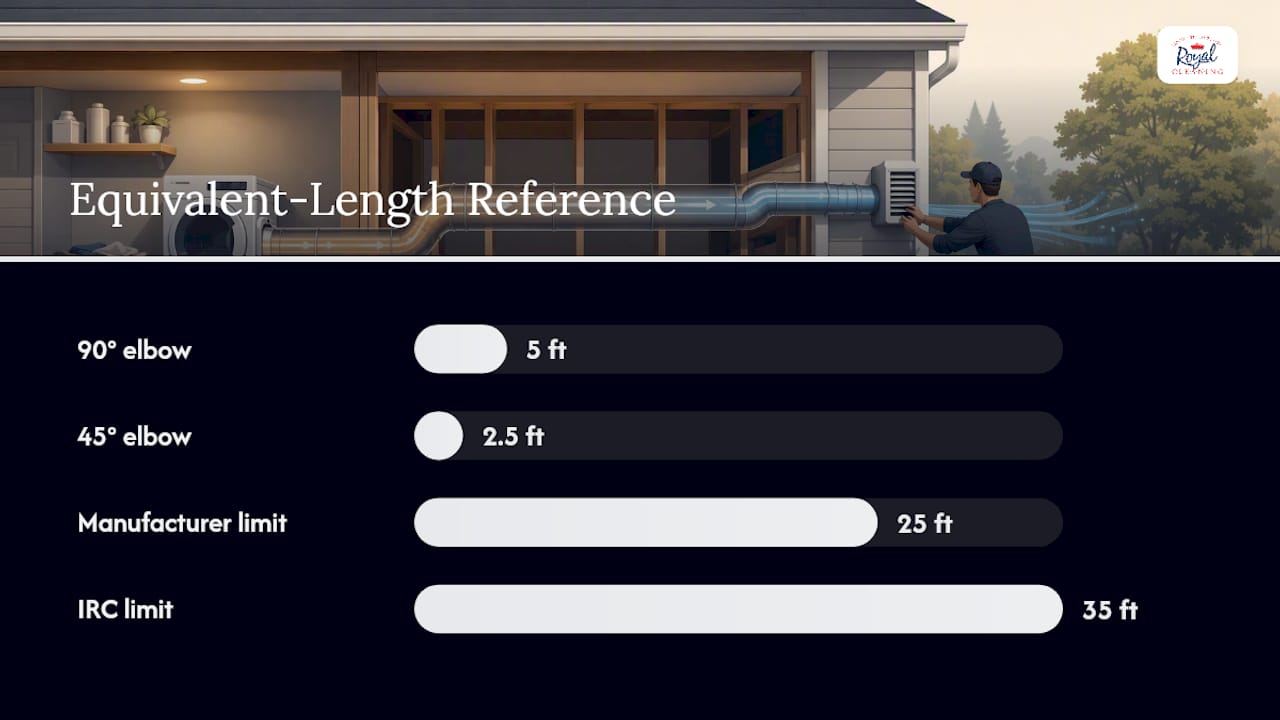
- Add 5 feet for every standard 90-degree elbow. These sharp turns create the most airflow resistance.
- Add 2.5 feet for every 45-degree elbow. Shallower bends cost half as much.
- Subtract for long-radius sweeps if your inspector or manufacturer allows it. Smooth, large-radius elbows carry a lower equivalent length than sharp-turn fittings, sometimes dramatically so.
- Compare the total to both limits and use whichever number is smaller.
Here’s a worked example. Say you’ve got a certain length of straight rigid duct, two standard 90-degree elbows, and one 45-degree elbow. Add the equivalent length penalties for each elbow to the actual duct length to get the total equivalent length. Under the IRC’s 35-foot maximum, you’d technically squeak by. But if your dryer’s installation manual caps equivalent length at 25 feet, that same run fails, because the manufacturer’s shorter limit governs both your warranty and, in most jurisdictions, your code compliance.
Transition duct (the short flexible connector between the dryer and the wall) doesn’t count toward the main run length, but it has its own restrictions on length and listing, which we’ll cover in the materials section below.
What Long Dryer Vent Runs Do to Performance and Safety
Every extra foot of ducting and every added elbow chips away at airflow. A dryer moves a fixed volume of hot, moist air, and the farther that air has to travel through a long vent pipe, the more resistance it fights. The result shows up fast: cycles that used to take 40 minutes stretch to 60 or 90, and your energy bill climbs because the dryer’s heating element runs longer to compensate.
Lint doesn’t distribute evenly along a long run. It settles at elbows, at the transition connector, and especially at the exterior cap, where cooling air causes moisture and lint to clump together.
Vent-related dryer fires are a well-documented hazard, and industry guidance links reduced airflow directly to increased ignition risk in ducts that run long or collect lint at bends.
Watch for these symptoms, which homeowners often blame on a failing appliance instead of a vent problem:
- Clothes come out damp or still warm after a full cycle.
- The dryer feels hot to the touch on the exterior cabinet.
- You notice a persistent burning or musty smell during operation.
- The laundry room feels noticeably more humid than usual.
- Lint shows up around the dryer door gasket more than normal.
Best Materials and Installation Practices for Long Runs
Long runs punish bad materials and sloppy installation choices far more than short ones. The margin for error shrinks with every added foot.
Rigid, smooth-wall metal duct at a 4 inch minimum diameter is the standard for the primary run, and it’s not optional once you’re dealing with any real distance. Flexible foil or accordion-style ducting is prohibited for long runs because the ridges inside it catch lint and multiply airflow resistance at every fold. Rigid duct with a slight downward slope toward the exterior lets condensation and stray lint drain out instead of pooling mid-run.
A few installation details separate a compliant long run from a fire hazard:
- Support the duct every 12 feet or so to prevent sagging that creates low spots where lint collects.
- Maintain a slight downward pitch from the dryer to the exterior, never uphill.
- Avoid kinks, crushed sections, or any reduction in diameter along the route.
- Keep transition duct (the flexible connector at the dryer itself) short and listed to UL 2158A standards.
- Never use screws through duct joints on the interior side. They snag lint and become nucleation points for buildup.
- Terminate outdoors with a damper that opens freely. Screens are prohibited because they trap lint against the opening.
Pro Tip: If your attic or crawl space run is long enough that you’ll need to service it more than once, install a mid-run access panel when you build it. Cutting drywall or roof decking later to reach a clogged section costs far more than planning for access up front.
Practical Solutions When Your Vent Run Is Too Long
If your equivalent-length calculation comes in over the limit, you’ve got options ranked roughly from least to most invasive.
- Reroute or shorten the path. This is the most permanent fix, but it usually means relocating the dryer, cutting a new exterior penetration, or repositioning laundry room plumbing. It’s worth it when the current layout forces excessive elbow counts.
- Swap standard elbows for long-radius sweeps. Engineering testing on large-radius fittings shows a 10 inch radius 90 degree sweep can carry an equivalent length of roughly 1.5 feet, compared to 5 feet for a standard sharp 90. Replacing two or three elbows this way can pull a failing run back under the limit without touching a single wall stud.
- Add a listed inline booster fan, but only when your dryer manufacturer and local code permit one. Booster fans must be interlocked with the dryer and installed somewhere accessible for maintenance, since they add a mechanical failure point that needs its own upkeep.
- Consider a ductless condensing or heat-pump dryer when no safe exterior vent path exists at all, such as in an interior room of a multi-story condo.
Before you pick a fix, weigh these factors:
- Cost and disruption of construction versus the price of new fittings.
- How permanent you want the solution to be. Rerouting is a one-time job; a booster fan needs ongoing attention.
- Whether your HOA or local permitting office requires a fitting change to be inspected.
Maintenance and Inspection Schedule for Long Dryer Vent Runs
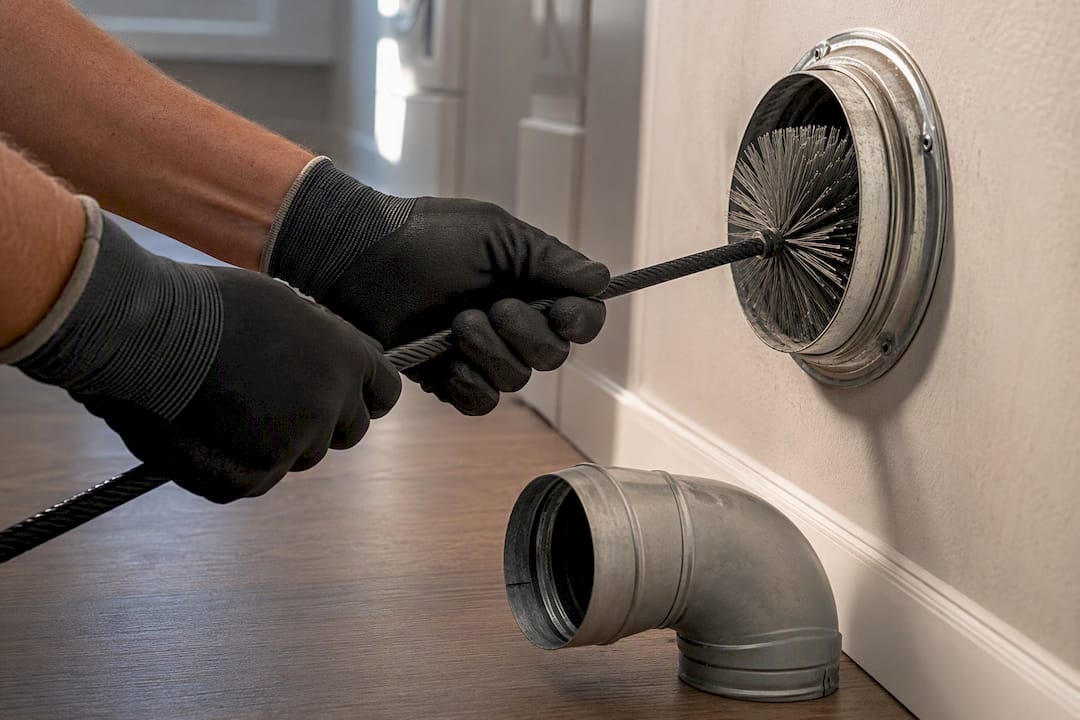
A run longer than 10 feet should get a professional cleaning at least once a year, and sooner if you notice drying times creeping up. DIY rod-and-brush kits work fine on short, straight runs, but they often can’t reach past two or three elbows in a long, bent route, which leaves the worst buildup exactly where you can’t see it.
A thorough inspection covers four spots every time:
- The transition duct connector behind the dryer.
- Every elbow along the route, since that’s where lint clings hardest.
- Attic or wall penetrations, where sagging or gaps can develop.
- The exterior termination cap and damper.
Pro Tip: Snap a photo of your exterior vent cap every few months. A flap that won’t close all the way, or visible lint fuzz around the opening, is often the first visible sign that the interior duct needs attention.
Professional dryer vent service typically goes further than a homeowner brush kit: rotary brush extraction pulls lint from the full length of the duct, not just the accessible sections, followed by an inspection of elbows and joints, a check of the exterior cap and damper function, and, when needed, replacement of damaged vent tubing or installation of a critter guard to keep birds and rodents from nesting in the termination point. If you’ve never had your dryer vents cleaned professionally, a long run with multiple elbows is exactly the scenario where it pays off most.
What We Actually See on Long Dryer Vent Runs
Most service calls for “my dryer stopped working” on a long run turn out to be the same two problems: a clogged elbow two or three bends into the ceiling, and a lint-packed exterior cap that’s barely opening anymore. The dryer itself is almost never broken. When we schedule an inspection, expect us to trace the full route, check every joint, and give you a clear picture of whether cleaning solves it or whether the run needs a fitting change.
— Bernadette
Get Your Long Dryer Vent Run Professionally Cleaned and Inspected
Royal Carpet and Tile Cleaning takes the guesswork out of a long, hard-to-reach vent run. Instead of renting a brush kit that can’t clear a duct with three elbows and an attic crossing, you get a rotary brush extraction that reaches the full length of the line, an inspection of every joint and elbow, and a check of the exterior cap and damper.

Our multi-step process includes optional upgrades built for long or aging runs, such as vent tube upgrades, additional vent tubing sold per foot, exterior vent door options, and critter guard installations to keep pests out of the termination point. Every job comes with transparent, upfront pricing and no hidden add-ons as provided on the company’s website. If your home has a run over 10 feet, multiple bends, or a dryer that’s taking longer than it used to, schedule dryer vent cleaning in Albuquerque and get a written estimate before any work begins.
Sources
- IRC 2024 dryer exhaust duct requirements | Jaspector
- Proper clothes dryer venting | BASC/PNNL resource guide
- Dryer vent installation and maintenance | Inspectapedia
- ASHRAE calculations | Dryer-Ell
FAQ
What Is the Maximum Length a Dryer Vent Can Run?
Most building codes allow up to 35 feet of equivalent length for a 4 inch dryer exhaust duct, but many dryer manufacturers set a shorter limit, often around 25 feet. Whichever number is smaller for your setup is the one you need to follow.
What Happens if My Dryer Vent Is Too Long?
Airflow drops, drying cycles get longer, and your energy costs rise as the dryer works harder to push moist air through the extra distance and elbows. Lint also collects more heavily at bends and the exterior cap, which raises fire risk over time.
What Are Some Solutions for Long Dryer Vent Runs?
Swapping standard elbows for long-radius sweeps can cut equivalent length dramatically, sometimes enough to bring a failing run back into compliance without any construction. Other options include rerouting the duct, adding a listed inline booster fan where code allows, or switching to a ductless condensing dryer if no safe vent path exists.
How Far Is Too Far to Run a Dryer Vent?
There’s no single “too far” number since it depends on elbow count, not just distance. A run measuring under 35 feet of equivalent length can still fail if your dryer manufacturer specifies a lower limit, so always calculate equivalent length rather than relying on straight-line distance alone.



