

 (505) 280-5216
Ink Stains on a Couch: Check the Care Code Before Alcohol
Blot the ink, never rub it, and test any cleaner on a hidden spot first, as University of Georgia Extension advises. For many ballpoint stains, controlled blotting with isopropyl alcohol is the first DIY option, using the paper-towel transfer method from the American Cleaning Institute. If your fabric is delicate or the stain is old, stop and call a professional.
TL;DR:
- Check the upholstery code before choosing a cleaner: W permits water based products, S requires solvent, WS allows either, and X permits vacuuming only.
- For W or WS fabric, start with mild dish soap; use rubbing alcohol only after a fiber test, changing white pads whenever ink transfers.
- Blot from the stain’s edges inward, use tiny amounts of liquid, and pretest hidden fabric; excess moisture can damage foam or leave rings.
- Stop after a few correctly matched attempts if ink no longer transfers; set ink, permanent marker, delicate fibers, and upholstery with an X code warrant professional help.
Table of Contents
- What should you do in the first 10 minutes?
- How do you match the treatment to your couch fabric?
- What are the step-by-step household methods that work?
- When is an ink stain too stubborn for DIY?
- Why is professional upholstery cleaning the safe next step?
- A conservative, safety-first approach to ink on a couch
- Ready to save your couch from a stubborn ink stain?
- FAQ
- Sources
What should you do in the first 10 minutes?
Speed matters, but so does restraint. Fresh ink sits near the surface of the fabric, and the wrong first move can push it deeper or spread it across the cushion. Gather your supplies before you touch the stain.
- White absorbent cloths or plain paper towels (colored ones can transfer dye)
- Cotton swabs and an eye dropper for small marks
- Isopropyl (rubbing) alcohol, mild dish soap, and distilled white vinegar
- Rubber gloves and an open window or fan for ventilation
Blot gently from the outside edge of the stain toward the center, so the mark does not grow. Switch to a clean section of cloth often. The American Cleaning Institute explains that a saturated towel can redeposit pigment back onto the fabric, so a fresh absorbent surface is part of the cleaning itself.
Do not rub, do not soak the cushion, and do not apply any chemical before a hidden-area pretest. If the care tag reads S, or you suspect acetate, silk, or wool, skip alcohol and acetone and consider professional help.
Pro Tip: Take a quick photo of the stain and the care tag before you start. If you end up calling a pro, those two pictures save time and help us advise you accurately.
How do you match the treatment to your couch fabric?
Every upholstered piece should carry a cleaning code, usually on a tag under a seat cushion or along the frame. That single letter tells you which cleaner family is safe, and it is the fastest way to avoid damage. It also helps to know whether your stain is oil-based ballpoint or water-based ink, since the code points you to the right approach. Manufacturer guidance on care label codes links water-based methods to code W and treats oil-borne stains as an S-code job.
- W: Use water-based cleaners such as diluted dish soap. Avoid solvents.
- S: Use a solvent or dry-cleaning fluid only. Water can leave rings and damage the finish.
- WS: Either water-based or solvent cleaners are acceptable. Start with the gentler one.
- X: Vacuum or brush only. Do not apply liquid cleaners; call a professional.
Fiber matters as much as the code. According to the University of Georgia guidance, alcohol can damage acetate, triacetate, modacrylic, and acrylic fibers, while ammonia can damage silk and wool. The University of Illinois Extension adds that acetone should never be used on acetate or acrylic, and that chlorine bleach and ammonia must never be mixed because the fumes are hazardous.
Key warning from University of Georgia Extension: Overwetting upholstery can push solvent into the backing and foam, and water can leave a ring as the fabric finish migrates. Use the smallest amount of liquid that wets the spot.
How to run a pretest
A pretest takes a few minutes and can save the whole couch. Follow these steps:
- Pick an inconspicuous area, such as the back skirt or the underside of a cushion.
- Dab a small amount of your chosen cleaner onto a white cloth and press it to the spot.
- Wait several minutes, then blot dry.
- Check the cloth for dye transfer and the fabric for color change, stiffness, or flattened pile.
If anything changes, do not use that cleaner. Our guide to pretesting on microfiber covers a small-patch method in more detail, which is especially useful for suede-like finishes that show marks easily.
One more point on fabric type: textured weaves such as chenille and bouclé hold ink in the loops, so you will need patience and several clean pads. Smooth microfiber releases ink more readily, but it also shows water rings quickly. Work in small, overlapping sections and let each area dry before judging the result.
What are the step-by-step household methods that work?
Work from the gentlest option to the strongest, and stop as soon as the stain stops lifting. Do not skip ahead. Each step below assumes you have already pretested and confirmed your fabric code allows it.
- Blot first. Press a dry white cloth onto the stain to pull up any ink still wet on the surface. Use a fresh section of cloth each time.
- Try dish soap (W and WS fabrics). Mix mild dish soap into water, following the product directions. Dampen a clean cloth, not the couch, and blot the stain from the edges inward. Follow with a cloth dampened in plain water to remove soap residue, then blot dry.
- Move to rubbing alcohol (if the fiber is safe). Dab a small amount onto a cotton swab or the corner of a white pad and press it against the ink. Do not pour. Press a dry pad on top and watch the ink transfer. Replace the pad the moment it picks up color.
- Use dry-cleaning solvent only for S-coded fabric. Apply it sparingly with a white cloth, with windows open and no flame or heat source nearby. Follow the manufacturer’s directions on the product.
- Use hydrogen peroxide only as a last resort. Reserve it for colorfast fabrics with certain dye-based inks, and pretest first, because it acts as a mild bleach.
Rubbing alcohol: the transfer-through technique
The American Cleaning Institute describes a transfer-through approach for washable fabric: place the stain facedown on clean paper towels, apply alcohol or cleaning fluid to the back, and replace the towels as ink transfers. That approach is not suitable for all upholstery unless the care instructions permit it, and a couch is rarely something you can flip over. On a couch, adapt the idea: hold a dry absorbent pad firmly against the stain and apply the alcohol in tiny amounts so the ink moves into the pad rather than spreading outward.
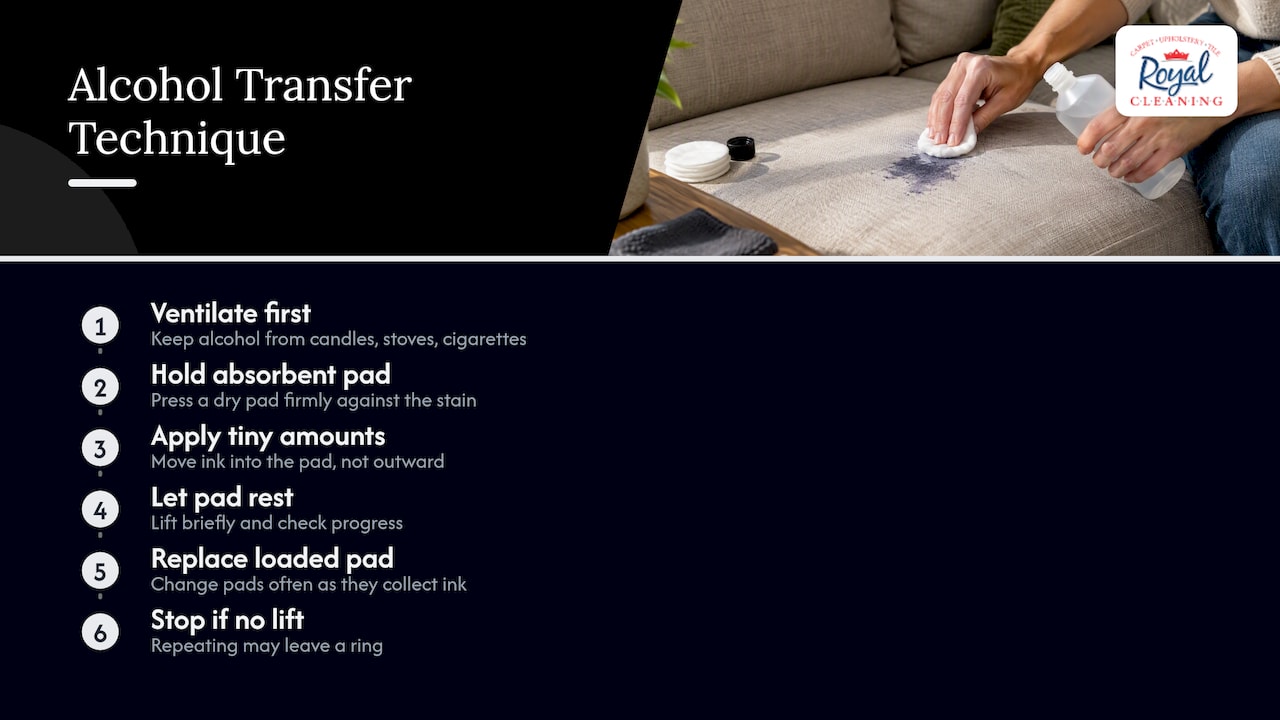
Use cotton swabs to pinpoint small marks, such as a pen line. Work from the edges inward, rolling the swab rather than dragging it. Change swabs and pads often, because a loaded pad can push pigment back into the weave. Let each pad rest against the fabric briefly before lifting, then check progress. If you see no lift, stop. Repeating the same step will not change the result and may leave a ring.
Alcohol is flammable, so keep it away from candles, stoves, and cigarettes, and ventilate the room while you work.
Dish soap: gentle and low risk
Dish soap is the safest first move on most water-safe fabrics. Because it cleans oily residue without strong solvents, it suits fresh ballpoint stains, particularly on microfiber and cotton blends. After blotting with the soapy cloth, rinse by blotting with a cloth dampened in plain water. Soap left behind attracts dirt and can leave a sticky patch that darkens over time. Dry the area with a clean towel and a fan, not a hair dryer on high heat.
Vinegar: a mild helper
A diluted white vinegar solution can help loosen some water-based ink marks and soften the residue left by soap. The University of Illinois Extension lists white vinegar solutions among common upholstery spot-cleaning materials. Apply a small amount to a white cloth, blot the stain, then follow with a water-dampened cloth to rinse. Vinegar is not a strong ink remover on its own, so treat it as a supporting step.
Hydrogen peroxide and other options
Some household advice mentions non-acetone nail polish remover and hair spray for ink. A consumer roundup on removing pen from a fabric couch lists dish soap, rubbing alcohol, non-acetone nail polish remover, and distilled white vinegar as typical household items. We advise caution with anything beyond soap and alcohol, since each extra product raises the chance of discoloration. Extension literature also notes that glycerine can help with ballpoint ink on washable fabrics, but that guidance targets laundry, not couch cushions with foam underneath.
| Method | Best for | Fabric codes | Key caution |
|---|---|---|---|
| Blotting with dry cloth | Fresh, wet ink | All except X | Never rub |
| Dish soap and water | Fresh ballpoint, light marks | W, WS | Rinse out all soap |
| Rubbing alcohol | Ballpoint and some marker | W, WS (test first) | Avoid acetate, triacetate, acrylic |
| Dry-cleaning solvent | Oil-based ink on S-coded fabric | S, WS | Ventilate; follow label |
| Hydrogen peroxide | Last resort, dye inks | Colorfast fabric only | Mild bleach; pretest |
Pro Tip: Let the cushion rest and dry fully between attempts. A stain that looks stubborn when damp often looks lighter once dry, and extra liquid is the fastest route to a ring.
For more everyday ideas, our post on home remedies for cleaning upholstery covers the basics of gentle spot care.
When is an ink stain too stubborn for DIY?
Not every ink comes out. Permanent markers, felt-tip pens, and India ink are formulated to resist water and rubbing, and a couch cushion is not a washable shirt. The American Cleaning Institute states plainly that some ballpoint, felt-tip, and liquid inks may be impossible to remove completely. Pushing harder rarely helps. Repeated aggressive attempts can fade the dye around the stain, so the cleaned patch ends up more noticeable than the ink was.
The bigger danger is what happens beneath the surface. The University of Georgia warns that solvents can damage backing and foam when upholstery is overwet, and that water can leave a ring as the finish migrates through the fabric. Once solvent has soaked into a cushion, you cannot reach it with a cloth, and it can leave odor, stiffness, or discoloration that spreads over time. Practical upholstery guidance from Utah State University points the same way: avoid over-wetting and dry promptly to prevent rings.
Use a simple rule. After a few controlled, correctly matched attempts, with rest and drying between each, stop. Then consider the situation:
- The stain has dried for days or weeks and no longer transfers to a pad.
- The fabric is acetate, silk, wool, or carries an X code.
- The ink is permanent marker, felt-tip, or a large spill that has soaked the cushion.
- The couch is valuable, antique, or sentimental. In that case, consider a professional or a textile conservator, and our partner’s guide on identifying valuable furniture can help you judge what you own before any treatment.
Stopping early is not giving up. It protects the options you still have.
Why is professional upholstery cleaning the safe next step?
Our technicians treat an ink stain as a controlled extraction job, not a scrubbing job. The process protects the backing and foam, which is where most DIY damage happens.
- Fabric identification. We confirm the fiber and cleaning code before choosing any product.
- Spot testing. We test our spotters on a hidden area, the same pretest we ask you to run, but with a trained eye for early signs of dye movement.
- Controlled solvent application. We apply measured amounts, so the cleaner stays in the fabric and out of the foam.
- Targeted extraction. Professional equipment pulls ink and cleaner out of the fibers rather than pushing it deeper.
- Rapid drying. Quick drying prevents rings, odors, and moisture trapped under the surface.
You should choose a pro when the fibers are delicate, the stain has set, the furniture is high value, or you suspect more DIY would make things worse. Our approach reduces risk compared with repeated home attempts because we control quantity, we use industry-grade spotters, and we extract rather than saturate. Our upholstery cleaning service is owner-operated, with transparent pricing, no hidden charges, and a satisfaction guarantee.
If you want to understand why regular professional care protects furniture beyond a single stain, our explainer on why you should get upholstery cleaned lays out the benefits. Pricing for ink stain work depends on the fabric, the size of the stain, and the piece of furniture, so we quote each job after seeing the details instead of listing a flat fee.
A conservative, safety-first approach to ink on a couch
My view is simple: test first and stop early. Fresh ink often lifts with patience, a clean pad, and a little alcohol or soap. Set ink often does not, and the urge to try one more product is what turns a small mark into a ruined cushion. Most of the damage I see comes from enthusiasm, not neglect.
If the tag is unclear or the couch means a lot to you, a professional inspection is worth far more than another round of experiments. Fabric that has been over-wetted or faded cannot be undone, but a stain left alone can still be treated well. When you are unsure, send us a photo of the stain and the care tag. We would rather give you honest advice before you start than repair a mistake afterward.
— Bernadette
Ready to save your couch from a stubborn ink stain?
When the fabric is delicate, the ink has set, or you simply want a lower-risk result, we are the safer alternative to repeated DIY attempts. Our upholstery cleaning for Albuquerque homes follows the same careful sequence described above, with the right tools and a trained eye.

- Fabric testing before any product touches the stain
- Spot treatments matched to your fiber and cleaning code
- Extraction that removes ink and cleaner instead of leaving them in the cushion
- Upholstery sealant application to help protect the fabric afterward
To get started, book our upholstery cleaning service and send us three details: a photo of the stain, a photo of the cleaning tag, and the approximate size of the mark. With those, we can tell you what is realistic before we arrive.
FAQ
Can toothpaste remove ink stains from a couch?
We do not recommend it. Toothpaste contains abrasives and dyes that can leave a residue or dull the fabric, and none of the extension guidance we reviewed lists it as an upholstery treatment. Stick to blotting, mild dish soap, or rubbing alcohol on fabrics that can take them, after a hidden-area test.
How do you get ballpoint pen ink off fabric?
Blot first, then use a small amount of rubbing alcohol on a white pad, changing the pad as it picks up ink. The American Cleaning Institute describes replacing towels as ink transfers as the key to the method. Pretest first, and stop if the fabric changes color.
Does Dawn dish soap remove ink stains?
A mild dish soap such as Dawn can lift fresh, light ballpoint marks on water-safe fabrics. Mix about 1 teaspoon with 1 pint of water, blot the stain, and rinse with a water-dampened cloth. It is a gentle first step, but it will not remove set or permanent ink.
How do you get permanent marker out of velvet?
Velvet is delicate and easily crushed, so we advise against home solvents on it. Permanent marker is also among the inks that may be impossible to remove completely. Leave the area untouched and contact a professional upholstery cleaner.
Sources
- Remove Stains From Ink (Ballpoint, Felt Tip, India, Mimeo, Stamp Pad) | Textiles
- Stain Removal Guide | The American Cleaning Institute (ACI)
- Upholstery Products and Tools ; Stain Solutions | U of I Extension



