

 (505) 280-5216
$79 Bait and Switch: 7 Vetting Steps to Avoid Duct Cleaning Scams
Scams and low-quality duct cleaning jobs are common enough that you should treat any unsolicited offer with caution, verify credentials, and confirm the work is actually needed before signing anything. The EPA and FTC both warn that legitimate need is narrower than most ads suggest. Pause any pushy sales pitch, ask for a written estimate, and never pay in full upfront or in cash.
TL;DR:
- Most duct cleaning scams, such as bait-and-switch pricing and fake certifications, rely on pressure tactics and remarkably low initial offers to lure homeowners.
- Genuine duct cleaning is thorough, methodical, and takes longer than one hour, with reliable providers inspecting the entire system and showing before and after evidence.
- The EPA recommends duct cleaning only for specific conditions like visible mold, pest infestation, or water damage, not for routine maintenance or general air quality improvement.
- Verifying licensing, requesting detailed written estimates, checking for proper containment equipment, and avoiding full upfront payments significantly reduce scam risks.
- In case of fraud, acting quickly by disputing charges, filing complaints, and collecting proof can help recover costs and prevent future scams.
Table of Contents
- Common scams and the exact tactics scammers use
- When duct cleaning is actually needed
- How to vet a contractor before you sign anything
- What a proper duct cleaning visit should look like
- If you were scammed: how to recover and report it
- Why transparent, documented service matters
- Help protecting your home’s air quality
- Sources
- FAQ
Common scams and the exact tactics scammers use
Duct cleaning scams follow familiar scripts, and once you recognize the pattern, they become easy to spot. The FTC and EPA both advice treating unusually cheap offers with skepticism because rock-bottom pricing is one of the clearest hallmarks of a home improvement scam.
- Bait-and-switch pricing: a $79 whole-house special that balloons into hundreds of dollars once the technician arrives and finds “extra” contamination.
- Door-to-door or social media pitches: someone claims to be “already in the neighborhood” and pressures you to book same-day.
- Fake certifications: claims of “EPA certification” do not hold up since the EPA does not certify individual duct cleaners.
- Instant mold tests and doctored photos: a swab turns colors in seconds or a phone photo shows extreme contamination that does not match what is actually in your ducts.
- Blow-and-go jobs: a technician spends under an hour, touches only the visible registers, and calls the whole system clean.
NADCA and industry guidance note that a genuine duct cleaning job is methodical, not quick. If someone insists the entire job takes under an hour, that timeline alone should raise questions.
Pro Tip: Ask any contractor claiming “EPA certification” to name the specific credential; there is no such federal certification for duct cleaners.
When duct cleaning is actually needed
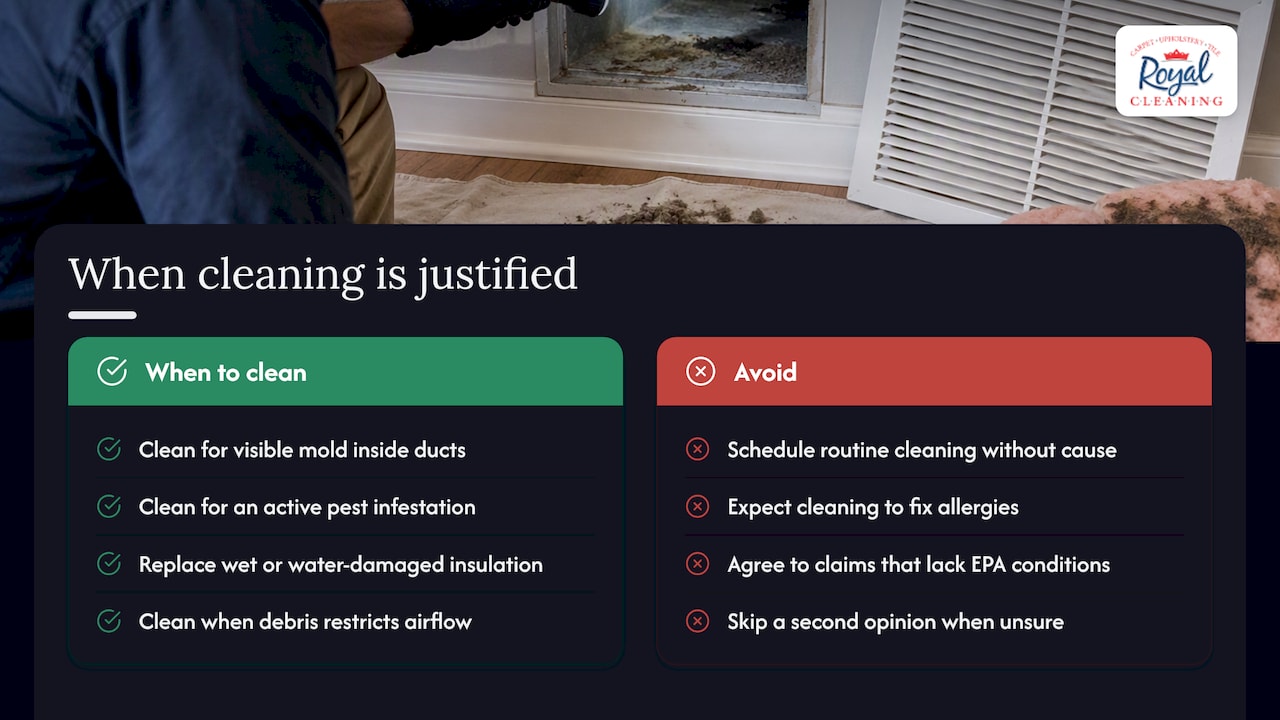
Most homes do not need routine duct cleaning, and the EPA is direct about the narrow conditions that justify it: substantial visible mold growth inside hard duct surfaces, an active pest infestation, water-damaged or wet insulation, or debris heavy enough to restrict airflow. Outside of those specific cases, the agency does not recommend cleaning on a set schedule.
A field study on mechanical duct cleaning found it removes adhered dust from sheet-metal surfaces and can improve airflow, but it did not consistently reduce airborne bioaerosols, and porous or wet insulation generally needs replacement rather than cleaning. (EPA NEPIS report)
That distinction matters when a salesperson promises cleaner ducts will solve allergy symptoms or eliminate dust throughout the house. Cleaning can address a specific, visible problem, but it is not a general-purpose air quality fix. Water-damaged porous insulation, in particular, usually needs to be replaced rather than treated, since only a qualified inspector or lab can reliably confirm mold. If a contractor’s claim does not match one of the EPA’s listed conditions, get a second opinion before agreeing to anything. Our guide on inspection frequency walks through how to judge whether your system shows real warning signs.
How to vet a contractor before you sign anything
A few minutes of verification up front can save you from a costly mistake later. Work through this checklist before any contractor sets foot in your home.
- Confirm licensing and insurance. Check your state or county contractor registry directly rather than trusting a number printed on a flyer.
- Ask for references and read reviews critically. Search the company name alongside “complaint” through your state attorney general’s office or the Better Business Bureau.
- Get three written estimates. Each should spell out scope, exclusions, and total cost, not just a per-vent teaser price.
- Confirm equipment and method. Ask whether the crew uses a high-powered vacuum collection system with containment, and whether they will access the air handler and blower, not just the registers.
- Request safety data sheets for any chemicals. If biocides or sealants are proposed, ask to see documentation before agreeing to their use.
- Set payment terms in writing. Avoid paying the full amount upfront, and never pay by cash, gift card, or wire transfer.
- Prefer credit card or check payment, tied to milestones or completion. This preserves your ability to dispute charges if the work falls short.
NADCA guidance echoes several of these points directly, warning specifically against instant mold tests and pushing for written estimates and proof of insurance before hiring anyone. Our checklist for evaluating providers covers additional verification steps if you want a deeper walk-through.
Pro Tip: Call the license number back through the state registry’s own phone line, not one printed on the contractor’s card, to confirm it is real.
What a proper duct cleaning visit should look like
A legitimate visit starts with inspection, not a sales pitch. The technician should show you the contamination they find and explain, in plain terms, why it meets one of the EPA’s criteria for cleaning.
- The scope covers registers, the duct runs themselves, the air handler, the blower, and coils where applicable, not just a quick pass with a shop vac.
- Equipment includes proper containment so dust and debris are captured rather than blown back into your living space.
- You should see before and after evidence, ideally video, showing the actual condition of your ducts.
- Biocides and sealants are used sparingly, if at all; the EPA cautions that research supporting their routine use is limited, and some products are only registered for bare sheet-metal surfaces.
- Red flags include surprise add-on charges, reluctance to produce paperwork, and a job that wraps up in a fraction of the time a full-system cleaning requires.
If any of these signs appear mid-job, you are allowed to stop the work and ask questions before it continues.
If you were scammed: how to recover and report it
Acting quickly improves your odds of getting money back and stopping the same operator from targeting your neighbors.
- Contact your card issuer immediately to dispute the charge if you paid by credit card.
- File a report with the FTC through ReportFraud.ftc.gov and notify your state attorney general and local consumer protection office.
- Submit a complaint to the Better Business Bureau so the pattern is documented publicly.
- Check whether the FTC’s Cooling-Off Rule applies. This rule can allow you to cancel certain in-home sales within a set window, a protection the FTC explains in detail.
- Gather your paperwork. Save the contract, receipts, photos of the work, and any texts or emails with the company, since these support both a card dispute and a formal complaint.
None of this requires special expertise, just a willingness to act before the trail goes cold.
Why transparent, documented service matters
We think the strongest defense against a bad duct cleaning experience is insisting on paperwork and proof at every step: a written scope, visible before and after evidence, and payment terms that do not require full payment upfront. That approach reflects how we operate, with a multi-step cleaning process and eco-friendly disinfectant options explained clearly before any work begins. If a contractor leans on scare tactics or pushes chemical treatments you were not expecting, get an independent opinion before agreeing to anything.
— Bernadette
Help protecting your home’s air quality
Spotting a scam is only half the job. If your ducts show genuine warning signs such as visible debris, pest activity, or water damage, you still want the work done right. We operate with transparent pricing and no hidden charges added after the fact. We walk you through our multi-step process before we start, so you see exactly what is included and what it costs. If you are also dealing with lint buildup or airflow problems in your dryer vent, our dryer vent cleaning service runs $159 to $229 depending on your setup, with accessories like a commercial-grade vent tube priced separately. Visit our air duct cleaning page to see our process and request a written estimate before you commit to anything.
Sources
- Should You Have the Air Ducts in Your Home Cleaned? | US EPA
- How To Avoid a Home Improvement Scam | Consumer Advice (FTC)
- Nine-home field study of mechanical air duct cleaning (EPA NEPIS report)
- National Air Duct Cleaners Association (NADCA)
FAQ
Is it a waste of money to have your air ducts cleaned?
It depends entirely on whether your home meets the EPA’s specific conditions, such as visible mold, pest infestation, or heavy debris blocking airflow. Cleaning without one of those triggers is not necessarily a waste, but it is not backed by EPA guidance as a routine necessity either.
What happens if you never clean air ducts?
For most homes, nothing serious happens, since the EPA does not recommend cleaning on a fixed schedule absent specific problems. Ducts with genuine mold growth, pest activity, or water damage can affect air quality, which is why those specific conditions warrant attention.
What can go wrong with duct cleaning?
A rushed or improperly equipped job can dislodge dust and blow it back into your living space instead of removing it, particularly when a contractor skips containment. Improper use of biocides or sealants is another risk the EPA specifically cautions against, since research supporting routine use is limited.
Does duct cleaning make a mess in your house?
A properly equipped job uses containment and a high-powered vacuum system that captures debris rather than releasing it, based on the process described in field research on mechanical duct cleaning. If a crew skips containment or uses inadequate equipment, dust can end up back in your rooms instead of removed from your system.



