

 (505) 280-5216
Dries in 20–60 Minutes: Encapsulation Carpet Cleaning for Maintenance
Encapsulation carpet cleaning uses polymer-based detergents that crystallize soil into brittle particles as they dry, so a vacuum can lift them out in as little as 20 to 60 minutes. It works best as interim maintenance between deep cleanings, keeping high-traffic carpet looking fresh without shutting down a room for hours. It is not a substitute for hot water extraction when carpet is heavily soiled, deeply stained, or holding onto embedded grit.
TL;DR:
- Encapsulation cleaning is ideal for low-to-moderate soil loads and low-pile carpets, but it struggles with oily stains and heavily embedded dirt.
- The method typically dries within 20 to 60 minutes, making it suitable for high-traffic commercial spaces that require quick turnaround times.
- Proper formulation and dilution are critical; poor-quality detergents or improper mixing can leave residues that cause sticky surfaces and faster re-soiling.
- Combining encapsulation with periodic hot water extraction offers a balanced approach for maintaining carpet appearance and extending carpet lifespan.
- Regular vacuuming over several days after service is crucial to fully remove crystallized soils and prevent residual residue or dullness.
Table of Contents
- How Does Encapsulation Cleaning Work?
- What Are the Benefits of Encapsulation Cleaning?
- When Should You Use Encapsulation Instead of Extraction?
- What Happens During a Professional Encapsulation Service?
- Encapsulation vs Hot Water Extraction: Which Fits Your Carpet?
- How Often Should You Schedule Encapsulation Cleaning?
- How Do You Care for Carpet After Encapsulation?
- How We Decide Between Encapsulation and Extraction
- What Carpet Fibers Work Best With Encapsulation?
- What Misconceptions Exist About Encapsulation Cleaning?
- How Do You Know If Encapsulation Cleaning Worked?
- Are There Health or Environmental Concerns With Encapsulation?
- The Case for Maintenance-First Carpet Care
- Ready for a Professional Encapsulation or Hybrid Program?
- Sources
- FAQ
How Does Encapsulation Cleaning Work?
The chemistry is the whole story here. Encapsulation detergents contain polymers that surround dirt particles while the solution is wet, then harden into a crystalline shell as the carpet dries. That shell keeps soil from re-adhering to fibers, which is the opposite of what happens with some older shampoo methods that leave sticky residue behind.
The mechanical side matters just as much as the chemistry. Machines built for this method use counter-rotating brushes or oscillating pads to work the solution into the pile and break the encapsulating polymers free from the carpet backing once they’ve dried.
A typical service cycle looks like this:
- Solution is sprayed onto the carpet at a controlled rate, often between 600 and 1,000 square feet per diluted gallon depending on the product and soil load.
- A brush machine agitates the fibers to distribute the polymer and lift soil to the surface.
- The carpet air-dries, usually within about 20 to 60 minutes, while the polymers crystallize.
- A vacuum pass removes the dried, brittle residue along with the trapped soil.
Formulation quality decides whether this process ends in a clean, dry carpet or a sticky mess. Poor dilution or a low-grade detergent is the most common cause of residue buildup, not the encapsulation method itself.
What Are the Benefits of Encapsulation Cleaning?
Speed is the headline benefit. Where hot water extraction can leave carpet damp for half a day, encapsulation typically dries within 20 to 60 minutes, which is why offices, retail floors, and busy households lean on it between deeper cleanings.
Pro Tip: If you’re scheduling a cleaning around a same-day event, ask specifically for encapsulation rather than a general “carpet cleaning” quote. The drying time is the whole reason the method exists.
The advantages compound from there:
- Low water use means less risk of overwetting, wicking, or mold growth in the padding.
- Lower labor time per visit translates into a lower cost for routine maintenance visits.
- Regular encapsulation passes reduce the abrasive grit that grinds carpet fibers down between full extractions.
- Fast turnaround keeps commercial spaces open, which is one reason the method has become standard in facility maintenance programs.
When Should You Use Encapsulation Instead of Extraction?
Encapsulation performs best on low-to-moderate soil loads and low-pile commercial carpet, the kind you find in offices, lobbies, and retail aisles. It struggles in a few specific situations.
- Oily or greasy stains resist the polymer’s ability to bind and crystallize, since the encapsulating action depends on the soil drying out.
- Heavily embedded dirt that has ground into the carpet backing often needs the flushing action of hot water extraction to actually pull it out.
- Plush, high-pile residential carpet can trap dried crystals deep in the fibers, where ordinary vacuuming may not fully retrieve them.
Pro Tip: If your carpet has a manufacturer warranty, check the required cleaning method. Some warranties call for periodic hot water extraction regardless of how often you encapsulate in between.
Persistent odors, visible staining that survives a vacuum, or a gritty feel underfoot are all signs it’s time for extraction rather than another encapsulation pass.
What Happens During a Professional Encapsulation Service?
A quality service follows a consistent sequence, and knowing the steps helps you compare quotes on more than just price.
- Pre-clean prep. The technician vacuums thoroughly, moves or pads furniture legs, and spot-treats any visible stains before the encapsulation solution goes down.
- Solution application. The detergent is diluted to manufacturer specifications and sprayed evenly, with machine passes overlapping slightly to avoid streaking or missed strips.
- Agitation. A brush or bonnet machine works the solution through the pile, distributing polymers and loosening soil.
- Drying. The carpet air-dries for roughly 20 to 60 minutes; some crews add air movers in low-ventilation rooms to speed things along.
- Vacuum removal. Once dry, a commercial vacuum lifts the crystallized residue, often followed by light grooming to reset the pile.
- Final walkthrough. The technician checks high-traffic zones and previously stained spots before handing the space back to you.
Reputable technicians follow the safety data sheet and manufacturer dilution guidance throughout, since over-concentrated solution is the fastest route to a sticky, hard-to-vacuum residue.
Encapsulation vs Hot Water Extraction: Which Fits Your Carpet?
These two methods aren’t competitors so much as teammates with different jobs. Encapsulation is a low-moisture maintenance method: fast drying, lower cost per visit, and built for keeping carpet looking presentable between bigger cleanings. Hot water extraction is restorative. It flushes soil and allergens out from deep in the pile using hot water and suction, which makes it the better choice for heavy soil, odor removal, or carpet that hasn’t been cleaned in a long time.
| Factor | Encapsulation | Hot water extraction |
|---|---|---|
| Drying time | 20 to 60 minutes | Several hours to a full day |
| Water use | Low | Higher |
| Best for | Interim maintenance, high traffic | Deep restoration, heavy soil |
| Typical cost per visit | Lower | Higher |
Because the two methods solve different problems, combining them into a hybrid program is common practice among facility managers and homeowners alike: encapsulation on a regular cycle, extraction once or twice a year to reset the carpet fully.
How Often Should You Schedule Encapsulation Cleaning?
Cadence depends on how much traffic the carpet takes. Commercial spaces with heavy foot traffic often schedule encapsulation monthly or quarterly, while residential carpet usually only needs it as an interim step between annual or semiannual extraction.
Pricing tends to move with a few practical factors:
- Square footage and the number of rooms or zones being treated.
- Traffic level, since higher-soil areas need closer attention and sometimes extra passes.
- Furniture and obstacle density, which affects how much prep time a visit requires.
- Spot treatment needs for stains that need pretreating before the main pass.
Sticking to a maintenance interval that fits your traffic pattern is one of the more overlooked ways to extend carpet life. Grit acts like sandpaper on fibers with every step, and regular encapsulation passes cut down on that wear between the deep cleanings that actually flush soil out.
How Do You Care for Carpet After Encapsulation?
The service isn’t finished when the technician leaves. Dried encapsulation crystals need repeated vacuuming over the following days to fully clear out, and a weak vacuum with poor suction won’t get the job done in one pass.
- Vacuum daily for the first two to three days after service, using a machine with strong suction and a beater bar if your carpet type allows it.
- Blot oil-based spills immediately rather than letting them soak in, since oily soil resists the encapsulation polymers on the next cleaning cycle.
- Book a hot water extraction if the carpet still feels gritty or looks dull after a week of normal vacuuming.
Pro Tip: Keep a lint-free cloth and a mild spot cleaner near high-traffic entry points. Catching a spill within minutes prevents the kind of embedded staining that pushes you toward extraction sooner than planned.
For homeowners who want a rundown of what to vacuum and how often between professional visits, our carpet cleaning tips page covers the basics in more detail.
How We Decide Between Encapsulation and Extraction
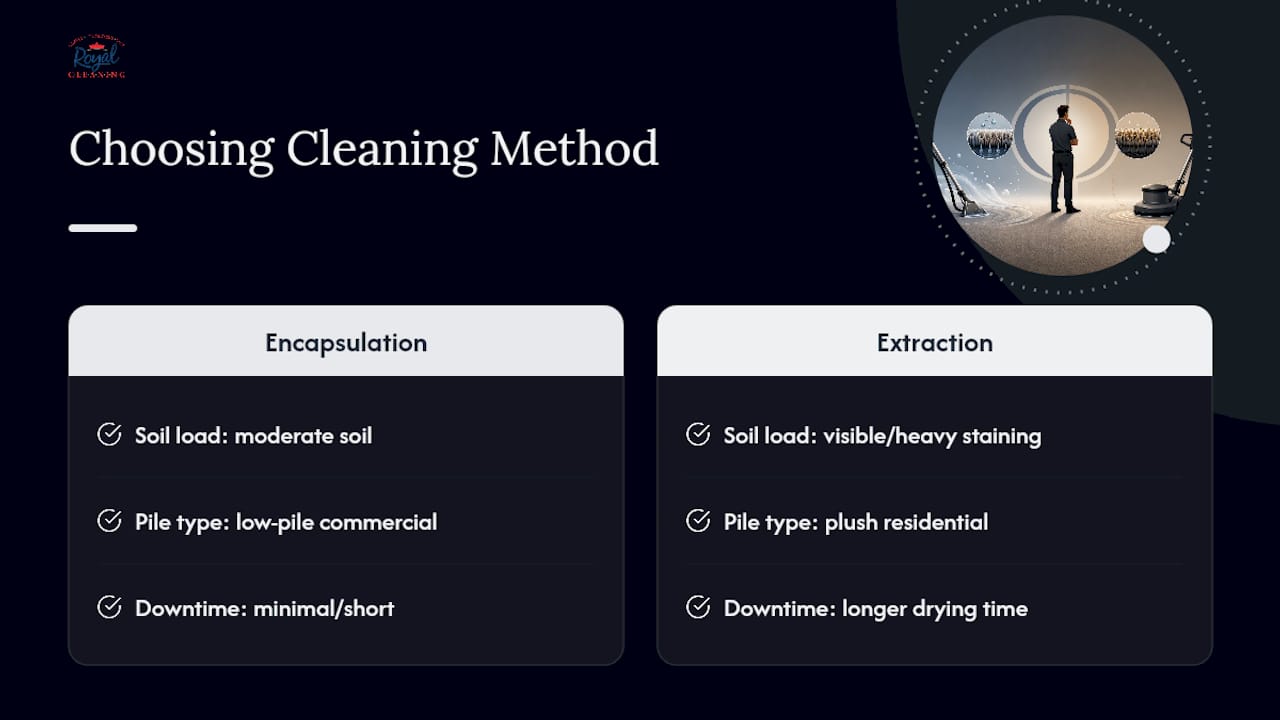
Royal Carpet and Tile Cleaning is a professional cleaning provider based in Albuquerque, New Mexico, and our team walks every job with the same questions: how heavy is the soil load, what’s the pile type, and how much downtime can the space afford? Low-pile commercial carpet with moderate traffic almost always points to encapsulation. Plush residential carpet with visible staining points toward extraction first, encapsulation second. That soil-and-pile assessment, not a fixed script, is what actually determines the right method for your floor.
What Carpet Fibers Work Best With Encapsulation?
Fiber type has a direct effect on how well encapsulation performs, and it’s one of the most overlooked variables when people choose a cleaning method.
Low-pile, tightly woven carpet, such as commercial-grade nylon and olefin (polypropylene), is the ideal match. These fibers sit close to the backing, so the polymer crystals form near the surface where a vacuum can retrieve them easily. Olefin also resists water absorption, which pairs well with a low-moisture method since there’s little risk of wicking soil back up from the padding.
Nylon carpet, the most common fiber in commercial settings, holds up well under encapsulation’s brush agitation without fraying or pilling, and it dries quickly given its low absorbency.
Fiber types that need more caution include:
- Plush or high-pile wool and wool-blend carpet, where crystals can settle deep into the fibers and resist a single vacuum pass.
- Frieze or shag styles, which have long, twisted fibers that make even agitation harder to achieve.
- Berber loop carpet, where snagging from brush machines is a real risk if the equipment isn’t set correctly.
None of these fiber types rule encapsulation out entirely. They just call for more careful vacuuming afterward, or a preference for extraction as the primary method with encapsulation used only between full cleanings. If you’re not sure what fiber your carpet uses, check the manufacturer tag or ask your cleaning technician to identify it before the first service.
What Misconceptions Exist About Encapsulation Cleaning?
A few myths follow this method around, and most of them come from confusing it with older, lower-quality shampoo systems.
“Encapsulation leaves a sticky residue.” This was a fair criticism of early carpet shampoos, which used surfactants that never fully dried and attracted new dirt almost immediately. Modern encapsulation polymers are formulated to crystallize completely, and any residue problem usually traces back to over-diluted or under-diluted detergent, not the method itself.
“It’s a cheap substitute for real carpet cleaning.” Encapsulation is a maintenance method, not a lesser version of extraction. Both have a job to do, and neither one replaces the other in a well-run care program.
“One encapsulation service is as good as a deep clean.” A single pass won’t flush out deeply embedded soil or allergens sitting in the carpet padding. That’s a job for hot water extraction, and expecting encapsulation to do it every time sets up disappointment.
“Encapsulation doesn’t remove much dirt.” The crystallization process is specifically designed to bind soil so it lifts out with the vacuum. The results are visible on lightly to moderately soiled carpet. It’s on heavy, ground-in soil where the method reaches its limit.
“All encapsulation products are the same.” Some formulas include oxygen or enzyme boosters for organic soils like pet accidents, while others use plant-based ingredients for homes or offices with chemical sensitivities. The product matters as much as the process.
How Do You Know If Encapsulation Cleaning Worked?
A successful encapsulation service leaves a few clear signs behind. The carpet should look visibly brighter in traffic lanes, feel dry to the touch within the expected 20 to 60 minute window, and show no leftover tackiness once fully dry. Pile should stand upright rather than looking matted, and there shouldn’t be any visible white or powdery residue left after the follow-up vacuuming.
Watch for a few warning signs that something went wrong:
- Sticky or tacky feel after drying usually means the solution was diluted incorrectly or applied too heavily.
- Fast re-soiling, where the carpet looks dirty again within days, often points to leftover residue attracting new dirt rather than a failure of the method itself.
- Visible white streaks or powder after vacuuming means the crystals weren’t fully removed, which calls for a second, more thorough vacuum pass rather than a redo of the whole service.
- No noticeable brightening in high-traffic areas may mean the soil load was too heavy for encapsulation alone, and extraction should be the next step.
If a service leaves any of these problems behind, it’s worth raising it directly with the provider rather than assuming it’s just how the method works. A well-executed job shouldn’t leave residue or accelerate re-soiling.
Are There Health or Environmental Concerns With Encapsulation?
Encapsulation’s biggest environmental advantage is water use. Because the method applies far less liquid than hot water extraction, it carries a lower risk of the mold and mildew growth that comes from overwetting carpet padding, particularly in humid climates or poorly ventilated rooms.
Chemical safety comes down to the specific product a technician uses. Reputable encapsulation detergents list their ingredients and safety data on a manufacturer safety data sheet (SDS), which any professional service should be willing to share on request. Enzyme and oxygen-boosted formulas target organic soils like pet stains without relying on harsh solvents, and plant-based encapsulation lines exist specifically for households managing chemical sensitivities or homes with small children and pets.
Allergen impact is a mixed picture. Encapsulation lifts surface-level dust, dander, and pollen effectively, but it isn’t a deep-extraction method, so allergens embedded deep in the pile or padding may need periodic hot water extraction to fully clear out. For households managing allergies, that’s another argument for the hybrid approach rather than relying on one method exclusively.
Ventilation during and after the service also matters. Even low-VOC formulas benefit from open windows or air movement while the carpet dries, both to speed up the crystallization process and to clear any residual odor from the cleaning solution.
The Case for Maintenance-First Carpet Care
Most carpet care advice treats cleaning as an event: something you schedule when the carpet finally looks dirty enough to bother. That framing undersells what encapsulation is actually good at. Used on a regular interval rather than as a reactive fix, it slows the abrasive wear that grit causes between deep cleanings, which is the wear that actually shortens carpet lifespan.
The conventional advice to “just deep clean once a year and call it done” misses the fact that most carpet damage happens gradually, from foot traffic grinding soil into fibers day after day. A single annual extraction can’t undo eleven months of that wear on its own.
If you take one thing from this guide, prioritize the interval over the intensity. A carpet on a steady encapsulation cycle, backed by an annual extraction, holds its appearance and structure far longer than one that gets an occasional aggressive deep clean and nothing in between. Match the method to your actual soil and traffic pattern, not to whichever service sounds more thorough on paper.
— Bernadette
Ready for a Professional Encapsulation or Hybrid Program?
Maintenance programs can be built around actual traffic patterns instead of a one-size-fits-all schedule, allowing for fast-drying encapsulation between deeper cleanings rather than full extraction every time the carpet looks a little tired.

When you schedule a visit, expect a clear estimate based on square footage and soil condition, a walkthrough of the process before work starts, and a final inspection so you know exactly what was treated. Cleaning services may be provided to homes and businesses in local areas, with on-site assessment of pile type and soil load to recommend encapsulation, extraction, or a combination of both. If your office or retail space needs a recurring low-downtime program, our commercial carpet cleaning services page outlines how those maintenance cycles work. Ready to get a quote for your space? Reach out through our carpet cleaning page to schedule an estimate this week.
Sources
- How to Clean Carpet with Encapsulation — Hillyard
- Encapsulation carpet cleaning vs extraction — Bonnet Pro
- Sustainable advantages to encapsulation — Cleanlink
FAQ
What Are the Downsides of Encapsulation Carpet Cleaning?
It struggles with oily stains, heavily embedded soil, and plush high-pile carpet where dried crystals can get trapped in the fibers. It’s a maintenance method, not a substitute for periodic hot water extraction.
What Does Encapsulation Carpet Cleaning Mean?
It’s a low-moisture cleaning method where polymer-based detergent crystallizes around soil as it dries, allowing a vacuum to remove both the soil and the dried residue, typically within 20 to 60 minutes.
What Is the Best Type of Encapsulating Cleaner to Use?
The right choice depends on the soil type: oxygen or enzyme-boosted formulas work well on organic stains like pet accidents, while plant-based options suit homes or offices managing chemical sensitivities. A professional cleaning provider selects the formula based on carpet fiber and soil load rather than using one product for every job.
How Long Should You Leave an Enzyme Cleaner on Carpet?
Dwell time depends on the specific product’s label, but most enzyme-based encapsulation formulas need several minutes of contact before agitation to let the enzymes break down organic soil. Always follow the manufacturer’s safety data sheet and label instructions rather than guessing on timing.



