

 (505) 280-5216
Ditch the Chemicals! Best Carpet Cleaning Alternatives
Chemical Free Carpet Cleaning: Ditch Toxins in 2024!
Why Chemical-Free Carpet Cleaning is the Smart Choice for Your Home
Chemical free carpet cleaning offers safe, effective alternatives to traditional methods that rely on harsh chemicals. Here are your best options:
Top Chemical-Free Cleaning Methods:
- Hot Water Extraction (Steam Cleaning) – Uses high-temperature water and powerful suction
- Dry Steam Vapor Cleaning – Low-moisture method with sanitizing steam
- DIY Natural Solutions – Vinegar, baking soda, and plant-based ingredients
- Professional Eco-Friendly Services – EPA Safer Choice certified products
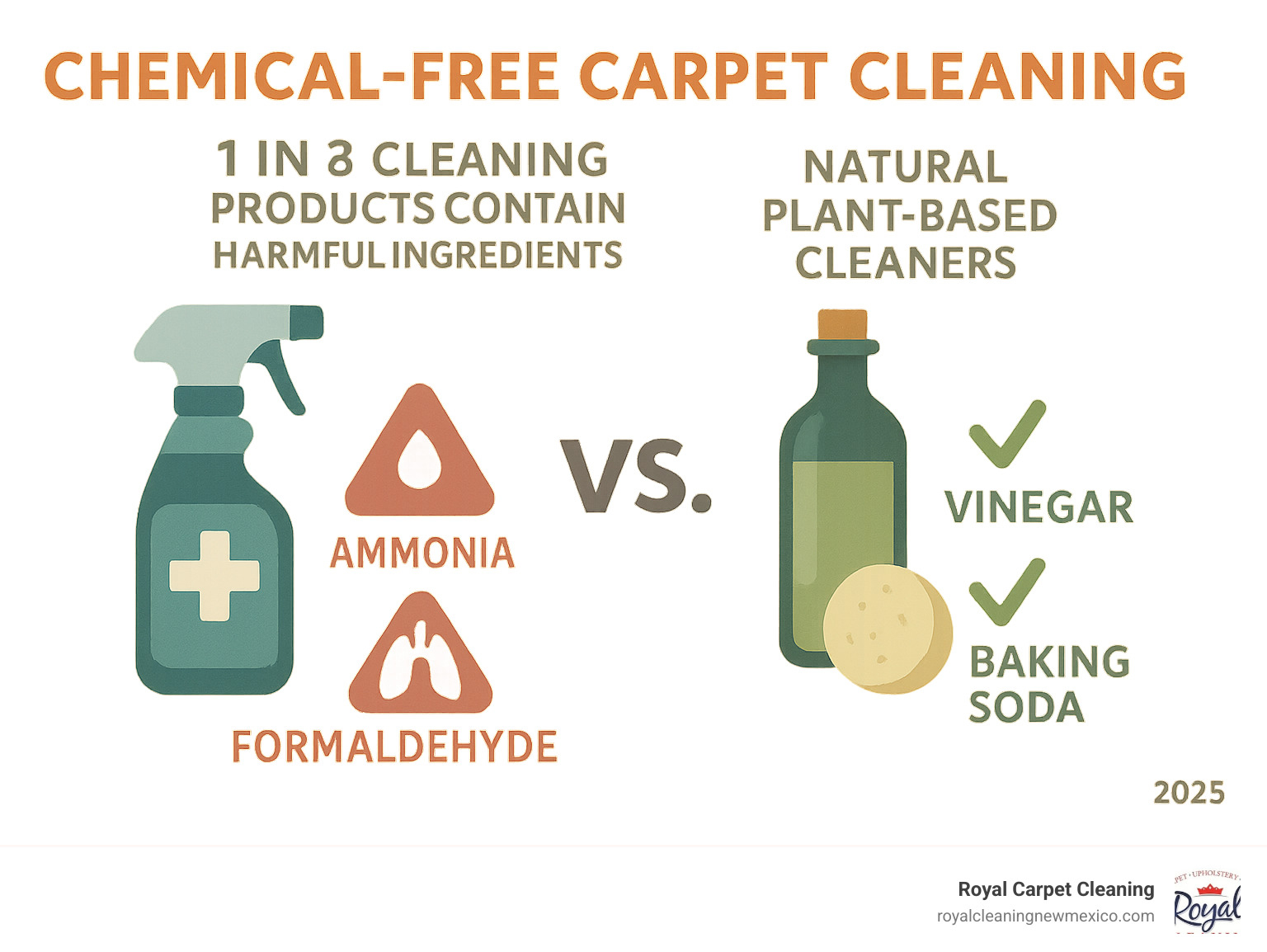
Did you know that 1 out of every 3 cleaning products contains ingredients that will either harm you or harm the environment? That’s a shocking statistic that many Albuquerque homeowners aren’t aware of when choosing carpet cleaning services.
Traditional carpet cleaners often contain toxic chemicals like ammonia, perchloroethylene (Perc), and formaldehyde. These substances can trigger asthma, cause respiratory issues, and leave harmful residues where your family and pets spend time.
The good news? You don’t have to choose between a clean carpet and a healthy home. Modern chemical-free cleaning methods can tackle tough stains, eliminate odors, and remove allergens just as effectively as their chemical-laden counterparts.
I’m Bernadette King RCC, and I’ve spent years helping cleaning companies develop safer, more effective processes that prioritize family health without sacrificing results. Through my experience in the carpet cleaning industry, I’ve seen how chemical free carpet cleaning methods can transform homes while protecting what matters most – your family’s wellbeing.
Chemical free carpet cleaning vocabulary:
Why Go Chemical-Free? The Health & Environmental Perks
Making the switch to chemical free carpet cleaning isn’t just about following the latest health trend – it’s about creating a genuinely safer home for everyone you love. When you choose non-toxic cleaning methods, you’re taking a stand for your family’s wellbeing while doing your part to protect our environment.
Think about it: your carpets are where your kids play, where your pets nap, and where you walk barefoot every day. Traditional cleaning products can leave behind invisible residues that continue affecting your family’s health long after the cleaning crew has left. Chemical free carpet cleaning eliminates this worry entirely.
The benefits go far beyond just avoiding that overwhelming \”chemical clean\” smell that forces you to open windows and leave the house. When you choose eco-friendly cleaning methods, you’re actively improving your indoor air quality. This means fewer allergy flare-ups, reduced asthma triggers, and cleaner air for everyone to breathe.
For families dealing with respiratory sensitivities or seasonal allergies – which many Albuquerque residents know all too well – this difference can be life-changing. Your carpets naturally collect dust, pollen, and other airborne particles. Using plant-based, biodegradable cleaning solutions means you’re removing these irritants without adding new chemical pollutants to the mix.
The environmental benefits are equally impressive. When cleaning products go down the drain, they eventually make their way into our water systems. Choosing biodegradable ingredients means you’re protecting local waterways and reducing your household’s environmental footprint.
If you’re dealing with specific health concerns, our specialized guides on Allergy Relief Carpet Cleaning and Asthma Safe Carpet Cleaning can provide targeted solutions for your family’s needs.
The Dangers Hiding in Traditional Cleaners
DIY Chemical-Free Carpet Cleaning Solutions
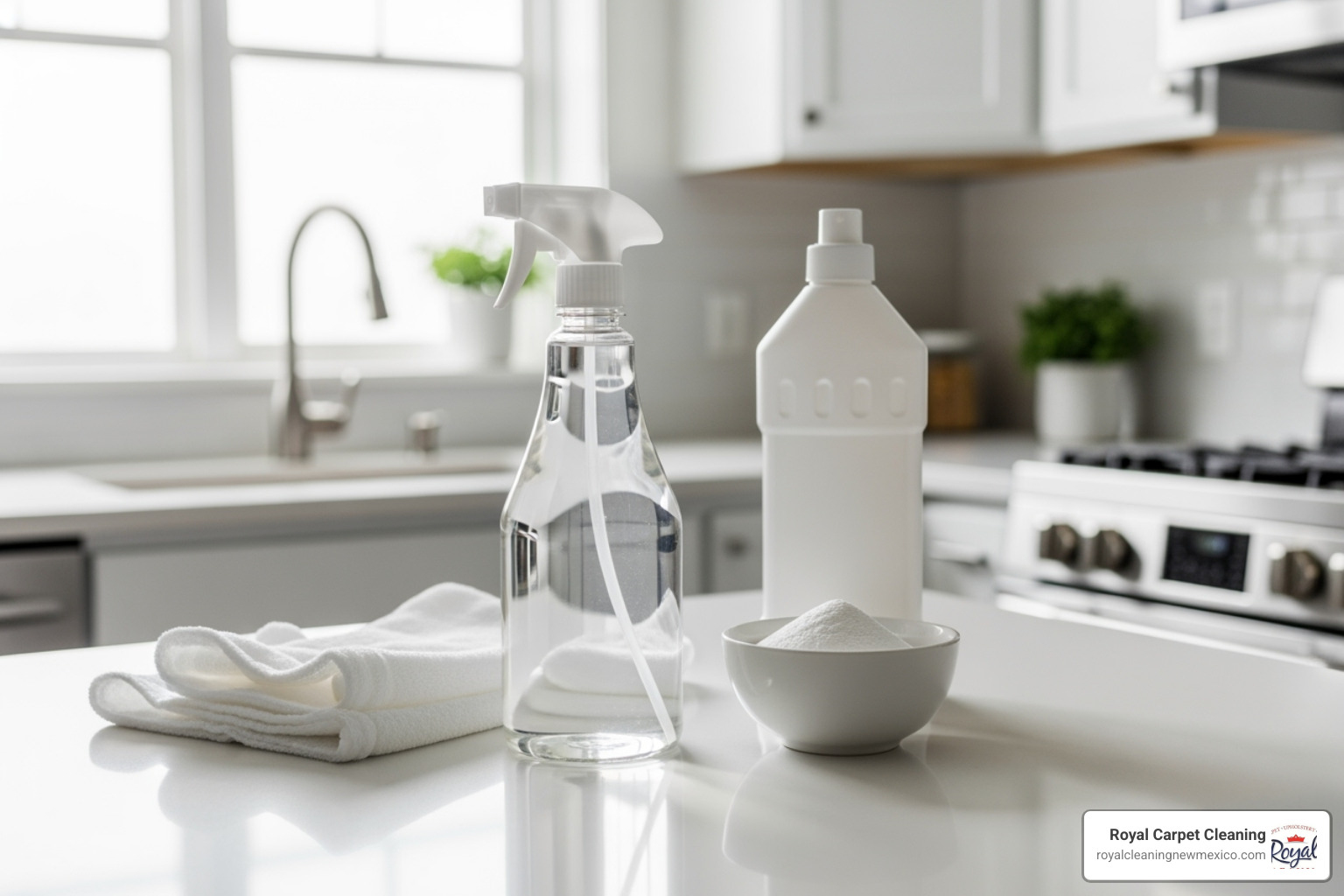
You don’t need to spend a fortune on expensive cleaners to keep your carpets fresh and clean. Chemical free carpet cleaning starts right in your own kitchen with ingredients you probably already have on hand. The best part? These natural solutions are incredibly cost-effective and work just as well as their chemical-laden counterparts.
I love how simple household items can tackle tough cleaning challenges. White vinegar acts as a natural disinfectant and breaks down stains, while baking soda works like a magnet for odors and helps lift stubborn dirt. Plant-based dish soap provides gentle cleaning power without introducing harsh chemicals into your home.
These DIY methods are perfect for spot treatments and regular maintenance cleaning. They’re safe for your family, gentle on your carpets, and won’t leave behind sticky residues that attract more dirt. For more creative cleaning ideas, check out our guide on 4 Everyday Products That Will Clean Your Carpet.
DIY All-Purpose Carpet Cleaner Recipe
This simple recipe has become my go-to solution for most carpet cleaning situations. It’s gentle enough for regular use but powerful enough to tackle everyday stains and spills.
You’ll need:
- 1 cup warm water
- 1/2 cup distilled white vinegar
- 1 tablespoon plant-based dish soap (fragrance-free works best)
Mix these ingredients in a spray bottle and shake gently. Always test the solution on a hidden area of your carpet first – this simple step can save you from any unwanted surprises.
Here’s how to use it: Spray the solution lightly on the stained area and let it sit for 5-10 minutes. The vinegar needs time to break down the stain while the soap loosens dirt from the carpet fibers. Blot with a clean cloth rather than rubbing, which can push the stain deeper into the carpet.
After blotting, rinse the area with clean water and blot dry. This rinsing step is crucial because it removes any soap residue that could attract dirt later. The beauty of this solution is that it works on most common stains while being completely safe for your family and pets.
Natural Deodorizer for a Fresh Scent
Baking soda is truly nature’s miracle worker when it comes to eliminating carpet odors. Unlike synthetic air fresheners that just mask smells, baking soda actually absorbs and neutralizes odors at their source.
Start by vacuuming your carpet thoroughly to remove surface dirt and debris. Then sprinkle baking soda evenly across the carpet surface. Don’t worry about using too much – baking soda is completely safe and won’t harm your carpet fibers.
Let the baking soda sit for several hours or overnight for best results. The longer dwell time allows it to absorb deep-seated odors. When you’re ready, vacuum thoroughly with a HEPA vacuum to remove all the baking soda along with the trapped odors.
For an upgraded version, try mixing 10-15 drops of essential oil with 1 cup of baking soda. Let this mixture sit for 30 minutes before applying to allow the oils to distribute evenly. Lavender provides a calming scent, while tea tree oil offers antimicrobial benefits.
Be cautious with essential oils around pets, especially cats, who can be sensitive to certain oils. For safe essential oil recommendations, visit our guide on Essential Oils You Can Use to Clean Your Home.
DIY Chemical-Free Carpet Cleaning for Tough Stains
Some stains need a little extra attention, but natural ingredients can handle even the most stubborn spots. The key is matching the right solution to the type of stain you’re dealing with.
For tough, set-in stains, create a paste using equal parts salt, borax, and vinegar. This combination creates a gentle abrasive that can lift stubborn dirt without damaging carpet fibers. Apply the paste to the stain and let it sit for 15 minutes before scrubbing gently with a soft brush. Rinse with clean water and blot dry.
Organic stains like blood or wine respond well to hydrogen peroxide. Mix 1 part hydrogen peroxide with 2 parts water and test in an inconspicuous area first – hydrogen peroxide can lighten some carpet colors. Apply to the stain, let sit for 10 minutes, then blot clean with a damp cloth.
Grease stains are actually easier to handle than you might think. Sprinkle cornstarch on fresh grease stains immediately – it acts like a sponge to absorb the oil. Let it sit for 30 minutes, then vacuum up the cornstarch. If any stain remains, follow up with your vinegar solution.
Pet accidents require special attention because of the odor factor. The fizzing action of vinegar and baking soda helps lift stains while neutralizing odors naturally. For detailed techniques and enzyme-based alternatives, check out our comprehensive guide on Tips for Removing Pet Urine from Carpet.
Professional Chemical Free Carpet Cleaning Methods
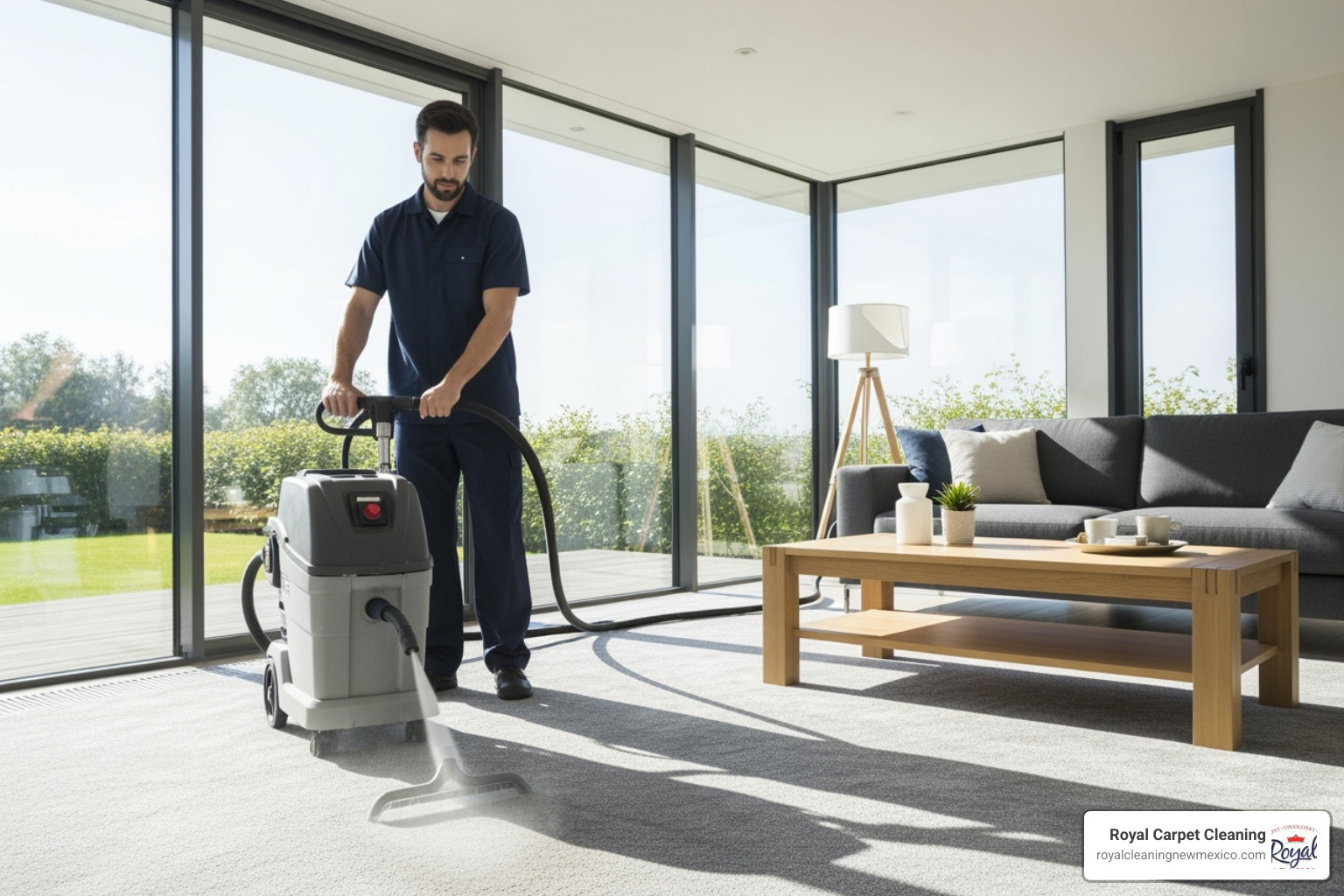
While DIY methods work great for everyday maintenance, sometimes you need the big guns. Professional chemical free carpet cleaning brings industrial-strength equipment and years of expertise to your home – without the harsh chemicals that make you worry about your family’s health.
Think of it this way: you wouldn’t perform surgery on yourself with kitchen utensils, right? The same principle applies to deep carpet cleaning. Professional services have access to specialized machines that can reach dirt and allergens buried deep in your carpet fibers, places your home vacuum can’t even dream of reaching.
At Royal Carpet Cleaning, we’ve spent years perfecting our multi-step process that combines powerful professional equipment with eco-friendly cleaning solutions. Our trained technicians know exactly how to handle different carpet types and stubborn stains without reaching for a bottle of toxic chemicals.
The real advantage comes from experience. Every carpet tells a story through its stains, and professionals know how to read that story and respond accordingly. What works perfectly on synthetic fibers might damage delicate wool, and that’s knowledge you gain through thousands of cleaning jobs.
For insights into what really works in professional cleaning, check out our article on Common Carpet Cleaning Myths.
Hot Water Extraction (Steam Cleaning)
Hot water extraction is the heavyweight champion of chemical free carpet cleaning methods. This process uses high-temperature water (around 200-220°F) combined with powerful suction to pull dirt, allergens, and contaminants from deep within your carpet fibers.
Here’s how it works: we inject hot water into your carpet, then immediately extract it along with all the dissolved dirt and debris. The high temperature does most of the heavy lifting, breaking down stains and killing bacteria, dust mites, and other allergens without needing harsh chemicals to do the job.
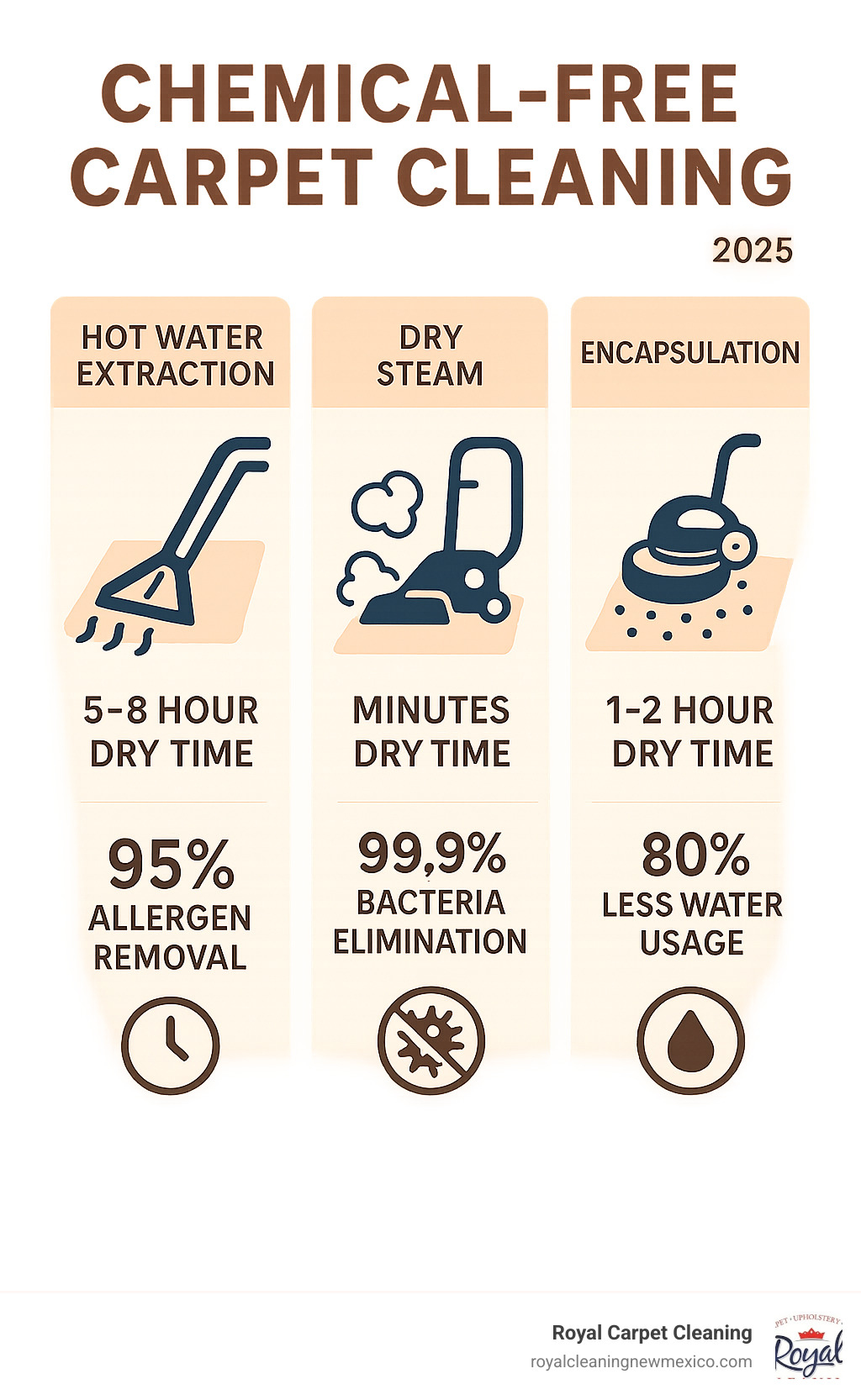
The results speak for themselves. Hot water extraction removes 95% of allergens and bacteria while leaving no chemical residues behind. It’s so effective that most carpet manufacturers actually recommend this method for maintaining your warranty.
The process is particularly effective on tough stains and persistent odors because the combination of heat and suction can reach contaminants that surface cleaning simply can’t touch. Plus, when done properly, it actually extends your carpet’s life by removing the abrasive dirt particles that wear down fibers over time.
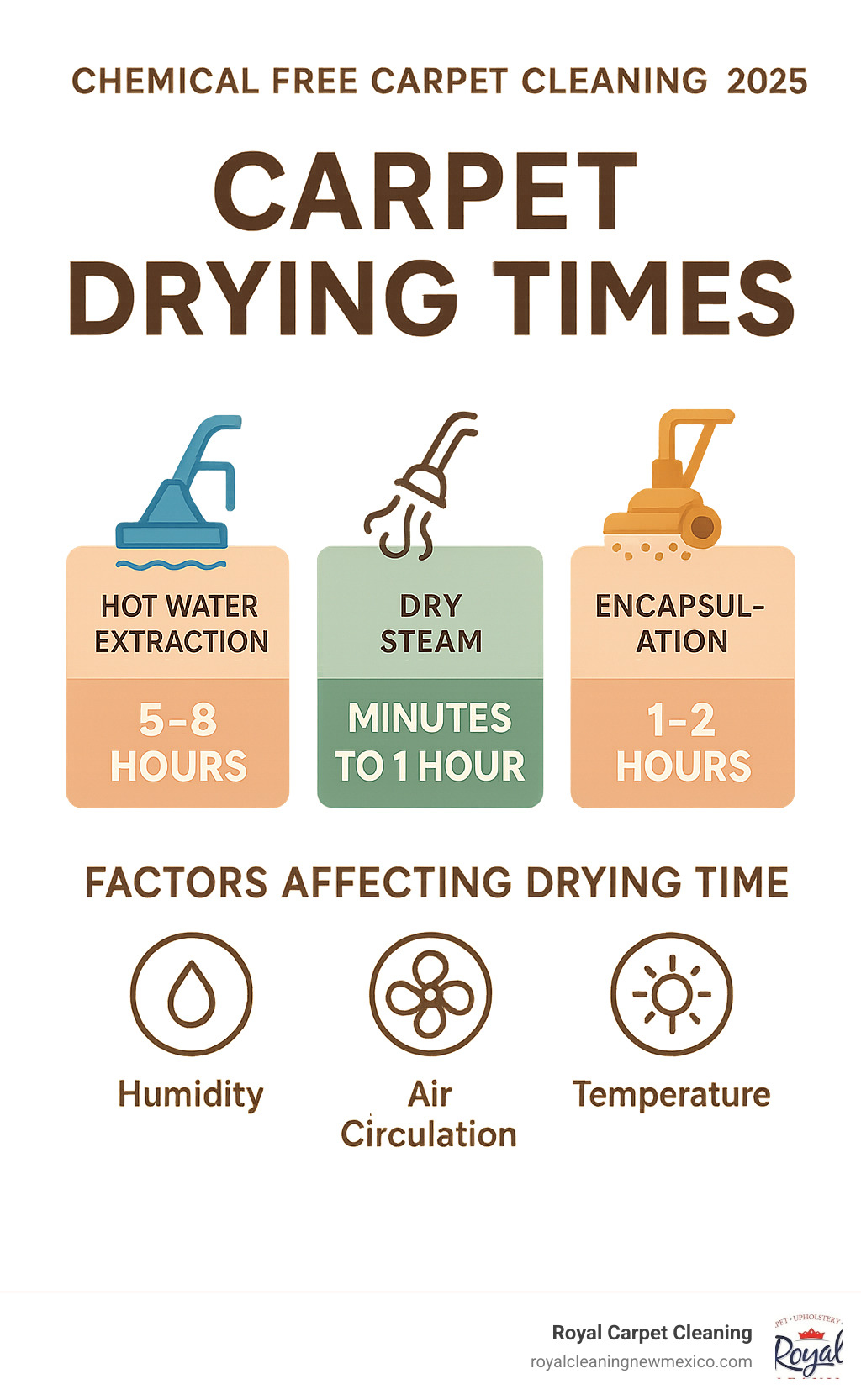
Drying time typically runs 5-8 hours, depending on humidity and air circulation. Good ventilation and air movement can cut this time significantly, and the wait is worth it for the deep clean you get.
For more professional cleaning insights, visit our Carpet Cleaning Tips page.
Dry Steam Vapor Cleaning
If hot water extraction is the heavyweight champion, dry steam vapor cleaning is the precision surgeon of chemical free carpet cleaning. This cutting-edge method uses high-temperature steam (240-280°F) with very low moisture content to sanitize and clean carpets.
The magic happens when water gets heated to create dry steam that penetrates carpet fibers and kills bacteria, viruses, dust mites, and other microorganisms on contact. The low moisture content means your carpets dry in minutes rather than hours – perfect for busy families or commercial spaces that can’t be out of commission for long.
This method is incredibly effective at killing 99.9% of bacteria and viruses while eliminating dust mites and allergens. It’s like having a sanitization superhero that works without any chemical weapons.
Dry steam cleaning is particularly valuable for homes with severe allergies, delicate or antique carpets, and situations where you need your space back quickly. The lack of moisture also means there’s no risk of mold growth, which can be a concern with traditional wet cleaning methods.
For more details on steam cleaning differences, check out this comparison of steam cleaning methods.
Encapsulation (Low-Moisture) Cleaning
Encapsulation cleaning is the environmental champion of professional carpet cleaning. This method uses crystallizing polymers to surround and trap dirt particles, which are then easily removed through vacuuming. It’s like having tiny crystal cages that capture dirt and march it right out of your carpet.
The process involves applying a cleaning solution containing special polymers. As the solution dries, it forms crystals around dirt particles. These crystals are then vacuumed away, taking the trapped dirt with them. It’s surprisingly effective and uses 80% less water than traditional steam cleaning.
This method shines in commercial spaces and high-traffic areas where minimal downtime is crucial. Drying times run just 1-2 hours, making it ideal for businesses that can’t afford to close for half a day.
The environmental benefits are impressive too. The water conservation aspect makes it a sustainable choice, and the lack of sticky residues means your carpets stay cleaner longer. It’s proof that being environmentally responsible doesn’t mean sacrificing cleaning power.
Frequently Asked Questions about Natural Carpet Cleaning
Is chemical-free carpet cleaning as effective as traditional methods?
This is probably the most common question we hear from families considering the switch to chemical free carpet cleaning. The short answer? Yes, absolutely! But let me explain why this matters so much for your home.
The effectiveness of cleaning isn’t just about removing visible dirt – it’s about creating a truly clean environment for your family. Plant-based surfactants work differently than synthetic chemicals, but they’re incredibly powerful at breaking down stains and lifting dirt from carpet fibers. In fact, research shows that 93% of clients who switched to alkaline water soap-free cleaning found it more effective than their previous chemical-based methods.
Here’s what makes chemical free carpet cleaning so effective: professional equipment combined with natural cleaning agents can remove 95% of allergens and bacteria without leaving any toxic residues behind. When we use hot water extraction with eco-friendly solutions, we’re not just cleaning your carpets – we’re creating a healthier environment for your children and pets.
For really tough stains, professional technicians have specialized techniques like dry steam cleaning, which destroys 99.9% of bacteria and viruses through heat alone. No chemicals needed, just the power of superheated steam.
The best part? You don’t have to choose between effectiveness and safety. Modern chemical free carpet cleaning methods deliver superior results while protecting what matters most – your family’s health.
Are natural and eco-friendly cleaning products safe for all carpet types?
While natural cleaning products are definitely safer than chemical alternatives, we always recommend testing any cleaning solution on a hidden area first. Every carpet is different, and what works beautifully on one might cause problems on another.
Wool carpets need special attention because natural fibers can be sensitive to certain pH levels. Even though vinegar is natural, its acidity can sometimes affect wool differently than synthetic materials. That’s why professional cleaners know to use pH-neutral solutions for these delicate fibers.
Synthetic carpets like nylon, polyester, and polypropylene are generally more forgiving and can handle a wider range of natural cleaning solutions. But even with these sturdy materials, we still test for colorfastness to make sure your carpet looks perfect after cleaning.
Your carpet’s warranty is another important consideration. Many manufacturers have specific requirements about cleaning methods and products. Using the wrong approach – even with natural products – could potentially void your warranty.
This is where professional expertise really shines. At Royal Carpet Cleaning, we understand the nuances of different carpet materials and can recommend the safest, most effective approach for your specific situation. We’ve seen too many DIY disasters where well-meaning homeowners damaged their carpets by using the wrong natural solution.
How long does it take for carpets to dry after eco-friendly cleaning?
Drying time is one of the biggest advantages of choosing the right chemical free carpet cleaning method. The timing varies dramatically depending on which technique we use, and understanding these differences can help you plan your cleaning day.
Hot water extraction typically takes 5-8 hours for complete drying, though we can often reduce this significantly with proper ventilation and air movement. The key is removing as much moisture as possible during the cleaning process itself.
Dry steam cleaning is amazing for busy families – your carpets are ready for use in just minutes to an hour at most. The low moisture content means no waiting around for carpets to dry.
Low-moisture methods like encapsulation fall somewhere in between, usually requiring 1-2 hours under normal conditions.
Several factors affect drying time, and understanding these can help you get the best results. Humidity levels play a huge role – cleaning on a dry day will always be faster than on a humid one. Air circulation is crucial, so we often recommend running fans or opening windows when weather permits. Temperature matters too – warmer rooms dry faster than cooler ones.
The thickness and density of your carpet also impacts drying time. Plush, thick carpets naturally hold more moisture than low-pile options.
Proper drying is essential for preventing mold and mildew growth. If your carpets aren’t completely dry within 24 hours, something’s not right with either the cleaning process or the environmental conditions.
Your Guide to a Cleaner, Healthier Home
Making the switch to chemical free carpet cleaning is one of the best decisions you can make for your family’s health and well-being. It’s not just about having clean carpets – it’s about creating a home environment where everyone can breathe easier and live healthier.
The benefits we’ve explored throughout this guide are real and lasting. When you choose natural cleaning methods, you’re protecting your children from harmful chemical exposure, safeguarding your pets from toxic residues, and improving your indoor air quality for everyone in your home. These aren’t small improvements – they’re life-changing choices that compound over time.
Empowerment through choice is what makes this journey so rewarding. You now have the knowledge to make informed decisions about your carpet cleaning needs. Whether you choose DIY solutions for regular maintenance or professional services for deep cleaning, you’re taking control of your home’s health.
For long-term carpet care, the secret is consistency. Regular vacuuming, prompt stain treatment with natural solutions, and periodic professional cleaning will keep your carpets looking beautiful and your home healthy. The natural approach actually helps extend carpet life because you’re not breaking down fibers with harsh chemicals.
DIY methods work wonderfully for spot cleaning and deodorizing, but there are times when professional expertise makes all the difference. Tough stains, deep-set odors, and annual maintenance cleaning benefit from professional equipment and techniques that you simply can’t replicate at home.
At Royal Carpet Cleaning, we understand that your family’s safety comes first. Our thorough multi-step process combines powerful professional equipment with eco-friendly solutions, ensuring your carpets receive a deep clean without compromising anyone’s health. We’ve built our reputation on delivering exceptional results while maintaining our commitment to non-toxic cleaning methods.
The peace of mind that comes with knowing your home is truly clean – not just surface clean, but deeply sanitized and safe – is invaluable. When your carpets are cleaned the natural way, you don’t have to worry about children playing on the floor or pets rolling around after cleaning.
For a truly deep, non-toxic clean that revitalizes your carpets safely, consider professional services that share your commitment to health and safety. Your family deserves carpets that are not only spotless but also completely safe for everyone who calls your house home.
Ready to experience the difference that chemical free carpet cleaning can make in your Albuquerque home? Get a free quote for your professional Carpet Cleaning service today!



