(505) 280-5216
Why Choose Insured Cleaners for Your Home
TL;DR:
- Hiring insured cleaners protects homeowners from potential damage, theft, and injury liabilities during cleaning services.
- Verification of proper coverage is quick and essential; requesting a certificate of insurance ensures the cleaner’s policies are active and adequate.
When you invite someone into your home to clean, you’re trusting them with your property, your belongings, and your family’s safety. Understanding why choose insured cleaners matters more than most homeowners realize. Many people focus on price and availability, overlooking the insurance question entirely until something goes wrong. A cleaner slips on a wet floor, breaks a valuable item, or causes water damage. Without proper coverage, you could be the one paying. This guide walks you through exactly what insurance covers, what you risk without it, and how to verify coverage before you hire.
Table of Contents
- Key Takeaways
- Why choose insured cleaners: insurance types explained
- Risks of hiring uninsured cleaners
- How insurance connects to service quality
- How to verify a cleaning company’s insurance
- My take on the real cost of skipping insurance
- Protect your home with Royal Carpet and Tile Cleaning
- FAQ
Key Takeaways
| Point | Details |
|---|---|
| Insurance protects your finances | General liability and bonding shield you from costs tied to damage, injury, or theft during cleaning. |
| Uninsured cleaners carry hidden costs | Hiring without insurance verification can leave you liable for medical bills and property repairs. |
| Verification is straightforward | Requesting a certificate of insurance takes minutes and confirms your cleaner is properly covered. |
| Professionalism follows insurance | Licensed, insured companies invest in training, background checks, and consistent service quality. |
| Bonding and insurance differ | A janitorial bond protects against employee theft; general liability covers accidents and property damage. |
Why choose insured cleaners: insurance types explained
Not all cleaning companies carry the same coverage. Understanding the main policy types helps you ask the right questions before signing anything.
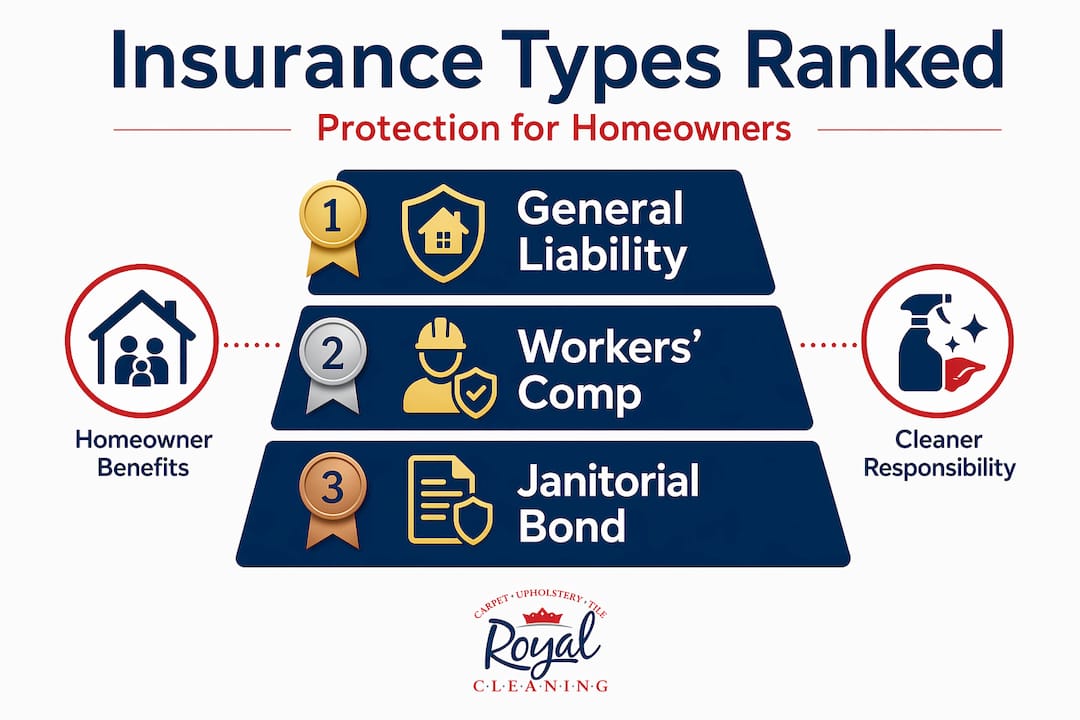
General liability insurance is the most critical policy for homeowners. It covers third-party property damage and bodily injury that happens during a cleaning visit. For context, enterprise contracts typically require $1 million to $2 million per occurrence in general liability, with $2 million to $5 million in aggregate coverage. That tells you how seriously large property managers take this protection.
One detail worth knowing: standard general liability policies exclude damage to items in the cleaner’s direct care, custody, or control. That means if a cleaner breaks a collectible while handling it, basic GL may not apply unless the company carries a Bailee’s coverage endorsement. Ask specifically about this when verifying coverage.
Workers’ compensation is the second policy type to confirm. Workers’ comp is often state-mandated for cleaning companies with employees, covering medical bills, lost wages, and therapy for injuries on the job. Chemical exposure, slips, and repetitive motion injuries are all common in this industry. If a cleaner gets hurt in your home and the company carries no workers’ comp, you could face a personal injury lawsuit.
Janitorial bonds work differently from insurance. Rather than paying out from a pool of premiums, bonds require the cleaning company to reimburse the bonding company if a claim is paid on their behalf. For you as a client, bonding means that if an employee steals something from your home, you have a documented path to compensation.
Here is a quick comparison of the three main coverage types:
| Coverage type | What it protects | Who benefits |
|---|---|---|
| General liability | Property damage, third-party injuries | Homeowner |
| Workers’ compensation | Cleaner injuries, medical costs, lost wages | Cleaner and homeowner |
| Janitorial bond | Employee theft from client property | Homeowner |
Risks of hiring uninsured cleaners
Skipping the insurance question might save you a few dollars on the hourly rate. What it can cost you is far more serious.
-
You absorb the medical bills. Wet floor injuries dominate general liability claims against cleaning companies. If an uninsured cleaner slips on your freshly mopped kitchen tile, your homeowner’s insurance may be your only fallback. That means a potential claim, a potential rate increase, and out-of-pocket costs up to your deductible.
-
Property damage falls on you. Without general liability coverage, a damaged countertop, a broken appliance, or a stained carpet becomes your problem to resolve through personal negotiation with the cleaner. There is no insurer to mediate or pay.
-
Theft has no remedy. Without a janitorial bond, a missing item from your home leaves you with little recourse beyond a police report. There is no financial recovery mechanism tied to the cleaning company.
-
Legal accountability disappears. An unlicensed, uninsured cleaner operates outside any regulatory framework. If something goes seriously wrong, you have no licensing board to file a complaint with and no insurer to escalate a claim to.
The real cost of cheaper, uninsured options becomes clear when you consider these scenarios together. Long-term financial risk from going uninsured far exceeds the initial savings on the hourly rate. That is not a theoretical risk. It happens to homeowners regularly, and the amounts involved are rarely trivial.
Pro Tip: Ask for insurance documentation before your first appointment, not after. Once a cleaner is already in your home, you have lost the most effective negotiating moment.
How insurance connects to service quality
Insurance and professionalism are not separate concerns. They are closely linked. A company that invests in proper coverage has also typically invested in the infrastructure that makes good cleaning possible.
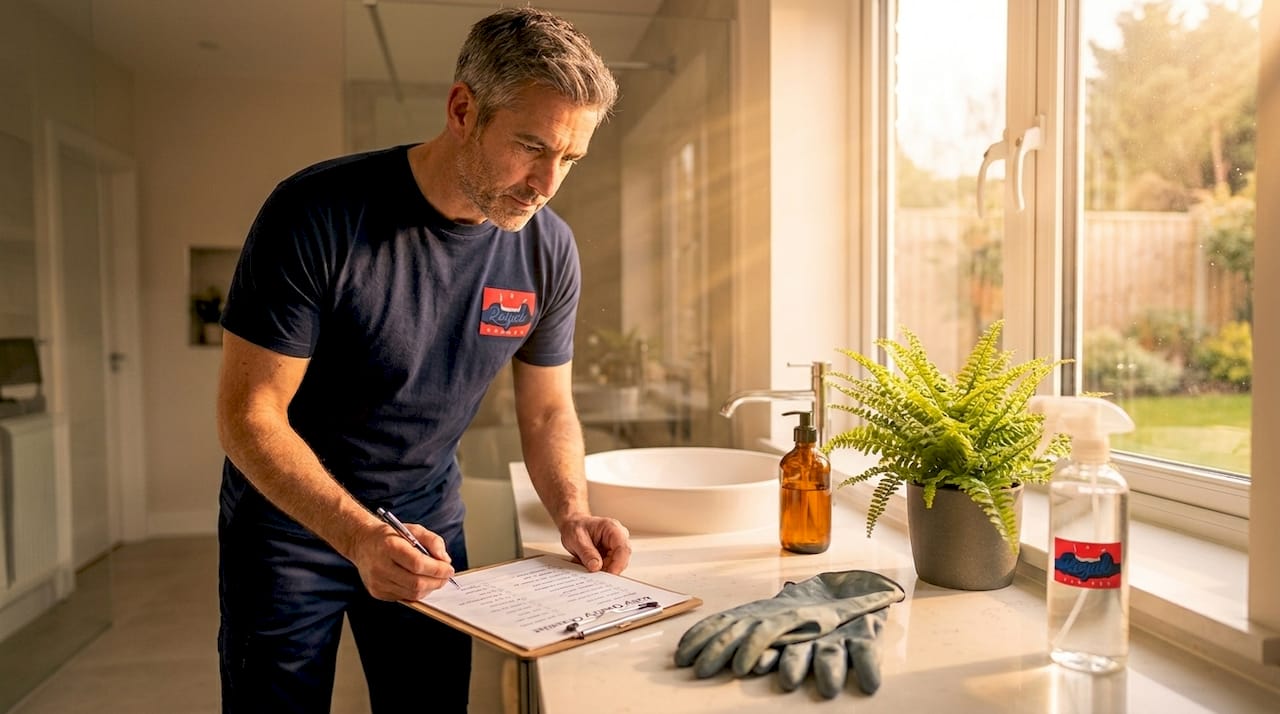
Licensed cleaning companies comply with local regulations and invest in training, background checks, and consistent standards. That compliance mindset carries through to every service visit. Cleaners know the products they are using, understand safe handling of chemicals, and follow procedures that protect your surfaces and your health.
Background checks deserve specific attention. Carrier premium credits are awarded to cleaning companies with documented screening programs, which means insurers financially incentivize thorough vetting. When a company runs background checks, their bonding costs go down. When their bonding costs go down, they keep doing it consistently. It is a system that works in your favor.
The advantages of insured cleaning services extend to your family’s daily wellbeing too. Families with young children, elderly relatives, or pets benefit from cleaners who use products correctly and handle your home’s surfaces according to manufacturer guidelines. You can find more about how professional standards protect your home’s health in a dedicated homeowner’s guide from Royal Carpet and Tile Cleaning.
“Insured cleaning companies treat your home with the same care they treat their business reputation. The coverage is not just paperwork. It reflects a commitment to doing the job right.”
Proper insurance is also a competitive signal. Insurance can be a competitive advantage for cleaning companies trying to win serious contracts. Companies that carry strong coverage attract better clients, which motivates them to maintain higher service standards over time. You benefit directly from that cycle.
How to verify a cleaning company’s insurance
Verification is simple when you know what to ask for. Here are the practical steps to confirm a cleaning company is properly covered before you let them into your home.
- Request a certificate of insurance. This is a standardized document your cleaner’s insurer produces on request. It lists the policy type, coverage limits, policy period, and the insurer’s contact information. Verification reduces your risk and confirms you are working with a properly covered provider.
- Check the coverage limits. A policy with $100,000 in general liability is far less protective than one with $1 million or more. Compare what you see against the industry norms mentioned in this article.
- Ask about bonding separately. Bonding and insurance are different documents. Request both and confirm the bond covers employee theft specifically.
- Check your state’s licensing requirements. Some states require cleaning companies to carry specific licenses, while others do not. Your local municipality may have its own rules. A quick search of your state contractor licensing board will tell you what applies.
- Call the insurer directly. Certificate documents can be altered. If you want absolute certainty, call the insurance company listed on the certificate and confirm the policy is active.
Pro Tip: Ask the cleaning company to list you as an additional insured on their general liability policy for the duration of the job. Not all companies offer this, but those that do provide an extra layer of direct protection.
Here is a quick reference table for the questions to ask before hiring:
| Question to ask | Why it matters |
|---|---|
| Can I see your certificate of insurance? | Confirms active general liability and workers’ comp coverage |
| Are your employees bonded? | Protects against theft in your home |
| What are your coverage limits? | Determines adequacy of protection for your property |
| Do you run background checks? | Signals professionalism and reduces theft risk |
| Are you licensed in New Mexico? | Confirms regulatory compliance in your state |
For more detail on what to look for when verifying cleaning credentials in the Albuquerque area, Royal Carpet and Tile Cleaning has a dedicated resource that walks through the process step by step.
My take on the real cost of skipping insurance
By Bernadette King
I’ve spent years talking with homeowners who hired someone “just once” without checking for insurance. Almost none of them planned to make it a habit. But when that one visit results in a broken tile, a stolen watch, or a cleaner’s sprained ankle, the story changes quickly.
What I’ve learned is that the money saved upfront rarely covers the cost of a single incident. I’ve seen homeowners pay out of pocket for repairs that a general liability policy would have handled in full. I’ve watched families discover that their homeowner’s insurance policy has gaps when it comes to third-party contractors working in the home.
The importance of insured cleaners is not just about legal protection. It is about peace of mind on an ongoing basis. When you know your cleaner is covered, you can leave for work, run errands, or simply enjoy the results without a lingering worry in the back of your mind.
My honest recommendation is this: treat insurance verification the same way you treat checking reviews. It takes five minutes and it tells you a great deal about how a company operates. A company that resists sharing their certificate of insurance is telling you something important. A company that produces it immediately, with clear limits and current dates, is telling you something even better.
— Bernadette
Protect your home with Royal Carpet and Tile Cleaning
At Royal Carpet and Tile Cleaning, every service we provide in Albuquerque, Rio Rancho, and surrounding areas is backed by proper licensing and insurance. You should never have to wonder whether the team in your home is covered. We carry general liability insurance and workers’ compensation, and we are happy to provide our certificate of insurance before your first appointment.
Our services include professional carpet cleaning, upholstery cleaning, tile and grout cleaning, air duct cleaning, and more. Each service is performed by trained, background-checked professionals who follow documented processes and use safe, effective cleaning products. If you want to know more about why certified cleaners make a difference for your home, we have the answers and the credentials to back them up. Contact Royal Carpet and Tile Cleaning today to request your free quote and insurance documentation.
FAQ
What insurance should a cleaning company carry?
A professional cleaning company should carry general liability insurance, workers’ compensation, and a janitorial bond at minimum. General liability covers property damage and injuries, workers’ comp protects employees injured on the job, and bonding protects you from employee theft.
What happens if an uninsured cleaner gets hurt in my home?
If an uninsured cleaner is injured in your home, you may be held personally liable for their medical bills and lost wages. Without workers’ compensation coverage from their employer, a lawsuit against the homeowner is a real possibility.
How do I know if a cleaning company is really insured?
Request a certificate of insurance and verify it directly with the insurance company listed on the document. Check that the policy is current, the coverage limits are adequate, and that both general liability and workers’ compensation are included.
Are insured cleaners more expensive?
Insured cleaning services may cost slightly more per hour than uninsured alternatives, but the financial risk difference is significant. One incident without coverage can cost far more than the total savings from choosing an uninsured cleaner.
What is a janitorial bond and do I need it?
A janitorial bond is a type of surety bond that compensates clients if a cleaning employee steals from their home. It is separate from insurance and requires the cleaning company to reimburse the bonding company for any claims paid. Yes, you want your cleaner bonded.