(505) 280-5216
The Role of Ventilation in Home Health: A Practical Guide
TL;DR:
- Proper ventilation is essential for maintaining indoor air quality and preventing pollutant buildup that harms health. Different system types, such as HRVs and ERVs, suit specific climates and improve air exchange efficiently when correctly installed and maintained. Enhancing ventilation through regular maintenance and source control reduces airborne infection risks and promotes overall home health.
Most people think of ventilation as the reason a room feels stuffy or fresh. That framing misses something significant. The role of ventilation in home health goes far beyond comfort. When your home doesn’t exchange air adequately, pollutants build up to concentrations that cause real symptoms: headaches, fatigue, eye irritation, and over time, serious respiratory damage. The EPA identifies ventilation as a primary exposure-control strategy, not a secondary feature. Understanding this is the first step toward protecting the people who live in your home.
Key Takeaways
| Point | Details |
|---|---|
| Ventilation is a health tool | Poor air exchange allows pollutants to accumulate and cause both short- and long-term health effects. |
| System type matters | HRVs suit cold, dry climates while ERVs work better in humid environments; choosing correctly makes a measurable difference. |
| Crowding amplifies risk | Low ventilation in occupied spaces significantly raises airborne infection exposure, especially in smaller homes. |
| Maintenance is non-negotiable | Poorly installed or unmaintained systems fail silently, allowing humidity and pollutant problems to grow undetected. |
| Cleaning supports ventilation | Air duct cleaning and surface cleaning reduce the pollutant load that ventilation systems must manage. |
The role of ventilation in home health
The industry term for what most people call “home ventilation” is indoor air quality management, and ventilation is its most powerful tool. At its core, ventilation is the process of replacing stale indoor air with fresh outdoor air while diluting or removing contaminants. Three basic types operate in most homes: natural ventilation through windows and gaps in the building envelope, mechanical ventilation from fans and HVAC systems, and infiltration, which is uncontrolled air movement through cracks and unsealed openings.
When ventilation rates are too low, pollutants accumulate. These include carbon monoxide from gas appliances, volatile organic compounds from furniture and cleaning products, moisture from cooking and bathing, and fine particles from candles or cooking smoke. Without adequate air exchange, concentrations rise to levels that affect your body, often before you notice anything unusual.
The EPA notes that symptoms from indoor air pollution can appear quickly after exposure, and many people mistake them for a cold or seasonal allergies. Common short-term signs include:
- Eye, nose, and throat irritation
- Persistent headaches and dizziness
- Fatigue that doesn’t improve with rest
- Worsening asthma or allergy symptoms
Long-term exposure carries much heavier consequences. The WHO reports 2.9 million premature deaths each year linked to household air pollution, with inadequate ventilation consistently identified as a key contributing factor. That figure covers households with poor cooking ventilation as well as homes that trap combustion products indoors. The health stakes extend well beyond occasional discomfort.
“Ventilation is not about making a room feel fresher. It is about controlling your exposure to substances that damage your health over months and years.” — Indoor air quality guidance, US EPA
Types of ventilation systems for homes
Not every ventilation solution works in every home. Spot ventilation, like the exhaust fan above your stove or in your bathroom, removes pollutants at the source before they spread. Whole-house ventilation goes further, cycling air throughout the entire living space on a continuous basis. Both serve different purposes and work best together.
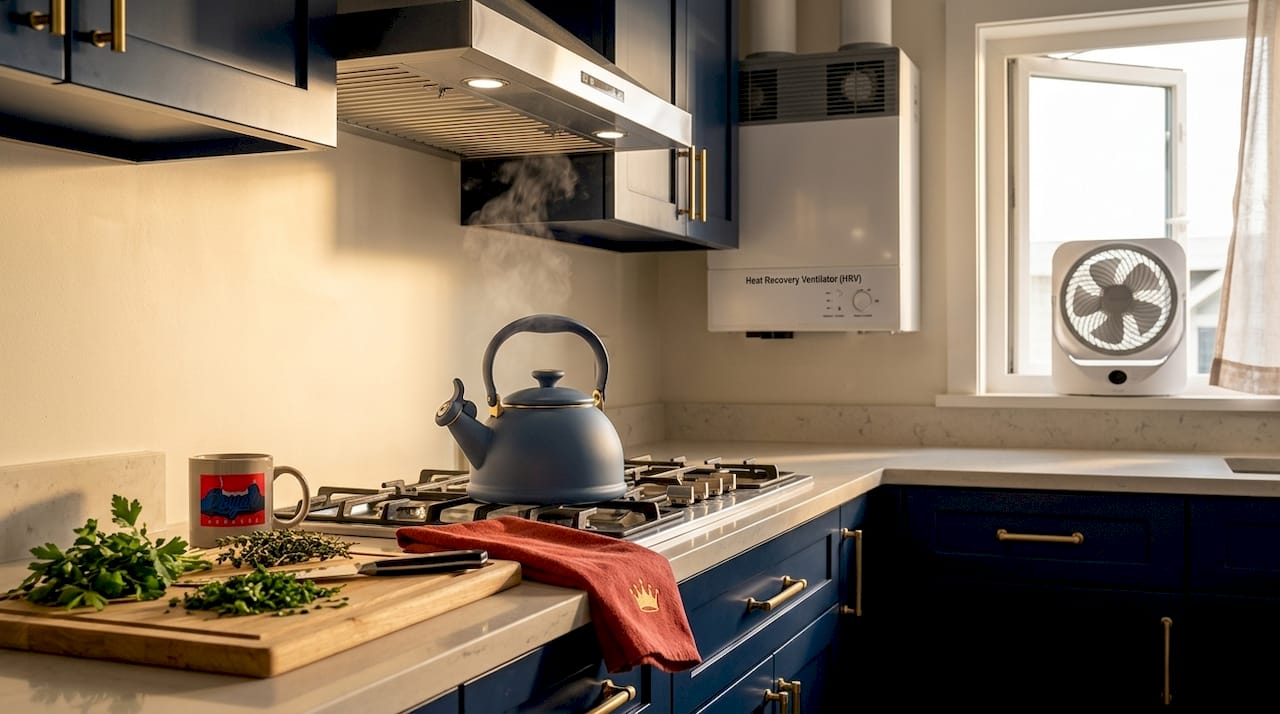
For homeowners who want more control and energy efficiency, two mechanical systems stand out.
Heat Recovery Ventilators (HRVs) pull fresh air in while recovering heat from the outgoing stale air. They work best in colder, drier climates where bringing in cold outside air would otherwise waste energy. Energy Recovery Ventilators (ERVs) do the same but also transfer moisture between airstreams, making them the right choice for humid climates where controlling indoor humidity is just as important as temperature.
The Department of Energy outlines dehumidifying ventilation systems as a third option for homes in persistently humid regions, where excess moisture alone creates mold and respiratory risks.
| Ventilation Type | Best Climate | Primary Function | Key Limitation |
|---|---|---|---|
| Natural (windows/gaps) | Mild, temperate | Basic air exchange | Uncontrollable, weather-dependent |
| Exhaust-only mechanical | Any | Removes stale air at source | Can depressurize the home, drawing in unfiltered air |
| HRV | Cold, dry | Fresh air with heat retention | Less effective at moisture transfer |
| ERV | Humid, hot | Fresh air with humidity balance | Reduced heat retention in cold climates |
| Dehumidifying ventilation | Humid | Moisture removal and air exchange | Higher installation and running costs |
Pro Tip: If you live in Albuquerque or the surrounding high-desert region, your dry climate favors an HRV over an ERV. Prioritize systems that bring in fresh air without adding moisture, since the arid conditions already work in your favor on humidity control.
Natural ventilation alone is rarely sufficient in a modern sealed home. Exhaust-only systems can create negative pressure, pulling in air through gaps in walls and foundations where radon, soil gases, or outdoor pollutants can enter unchecked. Climate-specific system design is not optional. It is the difference between a system that performs and one that creates new problems.
Ventilation and respiratory infection risk
This is where the research gets genuinely surprising. Most people understand that ventilation reduces odors. Far fewer realize it directly affects how likely you are to catch a respiratory infection inside your own home.
A study published in Nature Communications quantified the relationship between crowding, ventilation, and infection exposure. The findings show that increasing effective clean air flow by 8.7 to 17.6 liters per second per person produces a measurable reduction in airborne pathogen exposure. Current ventilation standards, the study notes, frequently fall short in crowded or smaller spaces where multiple people share air over extended periods.
The concept the researchers use is effective clean flow: the volume of pathogen-free air delivered to each occupant per second. It’s a more useful metric than simply measuring whether a fan is running. A fan that recirculates contaminated air without exchanging it with fresh outdoor air provides little protection.
| Scenario | Effective Clean Flow | Infection Exposure Risk |
|---|---|---|
| Well-ventilated, low occupancy | High | Low |
| Well-ventilated, high occupancy | Moderate | Moderate |
| Poorly ventilated, low occupancy | Low | Moderate |
| Poorly ventilated, high occupancy | Very low | High |
The public health implication is clear: combining better ventilation with managing how many people occupy a space and how long air sits before it’s cleared produces the strongest protection. This matters practically in households where multiple people live in a small footprint, which describes a significant portion of rentals and starter homes.
How to assess and improve ventilation at home
You don’t need specialized equipment to identify poor ventilation. Your home gives you signals. Condensation on windows in the morning, persistent musty odors, rooms that feel stale even with doors open, and recurring respiratory symptoms that clear up when you leave the house are all reliable indicators that air exchange is insufficient.
Here are the most effective steps you can take:
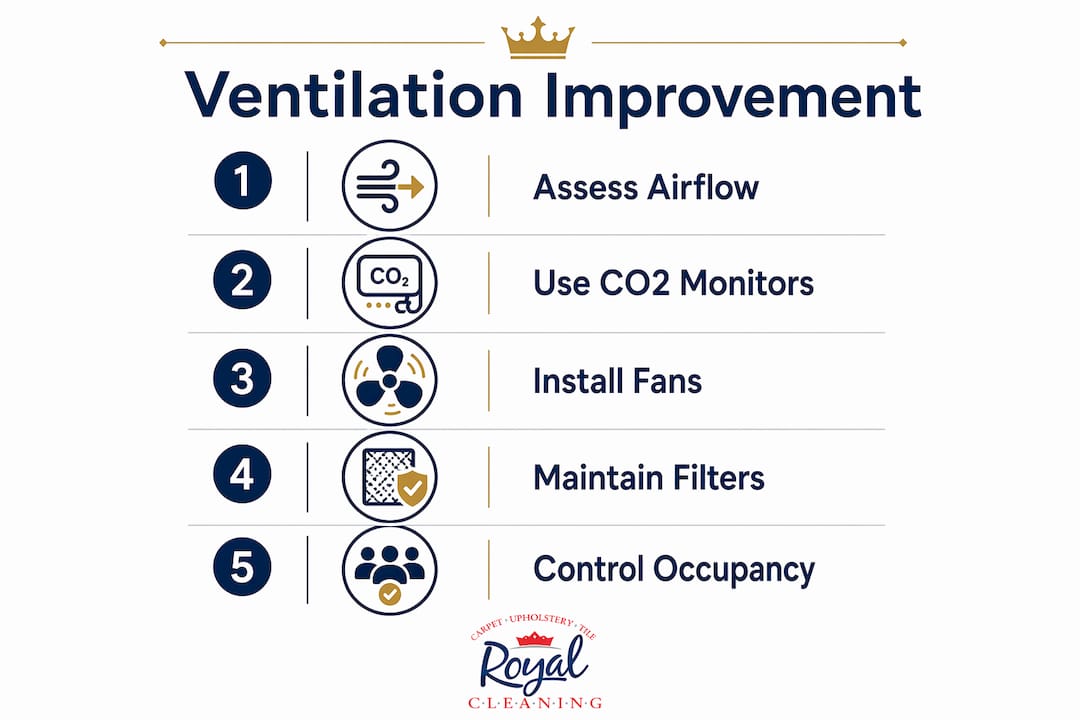
- Check exhaust fans regularly. Hold a tissue near your bathroom or kitchen exhaust fan while it runs. It should pull the tissue toward the vent. If it doesn’t, the fan is underperforming or blocked.
- Open windows strategically. Cross-ventilation works by opening windows on opposite sides of your home. A window cracked on the north side and one on the south creates a pressure difference that drives airflow without a fan.
- Monitor indoor humidity. Invest in an inexpensive hygrometer. Indoor humidity should stay between 30 and 50 percent. Above 60 percent, mold growth accelerates and respiratory irritants increase.
- Schedule air duct inspections. Duct performance directly affects how effectively your HVAC system distributes and refreshes indoor air. Dirty or leaking ducts undermine the entire system.
- Integrate source control. Always run your range hood when cooking. The WHO emphasizes that ventilation at the source of pollution, especially cooking, reduces fine particle exposure more reliably than filtration alone.
Monitoring matters as much as installation. Residential experts note that incorrectly sized or poorly ducted ventilation systems often fail to control humidity and air quality until visible damage already appears. A system that looks operational may be doing very little, which is why tracking indoor humidity and CO2 levels over time gives you actual performance data rather than assumptions.
Pro Tip: CO2 monitors are one of the most practical tools for assessing ventilation in real time. When CO2 levels climb above 1,000 parts per million in a room with the windows closed, that’s a direct sign the space needs more fresh air exchange. Budget-friendly monitors cost less than $50 and work immediately out of the box.
For renters, the options are narrower but not zero. You can install window fans, use portable air purifiers with HEPA filtration as a supplement, and document ventilation problems in writing to your landlord. Understanding indoor air safety practices gives you the language and evidence to make those conversations more productive.
My take on what most homes get wrong about ventilation
I’ve seen a lot of homes where the ventilation system technically exists but functionally does almost nothing. The bathroom fan vents into the attic instead of outside. The range hood recirculates rather than exhausts. The HVAC filter hasn’t been changed in two years and the airflow across the system has dropped by a third. These aren’t unusual situations. They’re the norm in homes that haven’t had a deliberate indoor air quality review.
What I’ve learned is that most homeowners treat ventilation like a light switch: either you have it or you don’t. The reality is closer to a spectrum, and most homes sit somewhere in the middle where the system runs but performs poorly. That middle ground is where the subtle health effects live. Chronic fatigue, recurring headaches, and worsening allergies get blamed on everything else before ventilation gets a second look.
The other thing I consistently see overlooked is the relationship between cleaning and ventilation. Dust, pet dander, mold spores, and allergens don’t disappear when a fan runs. They get distributed. If your ducts are loaded with debris and your carpets are holding allergens, your ventilation system is cycling those particles through your air continuously. Cleaning and ventilation are two parts of the same system. Neither works as well without the other.
— Bernadette
How Royal Carpet and Tile Cleaning supports your home’s air quality
Good ventilation does the work of moving air. What that air carries depends on how clean your home is underneath the surface.

At Royal Carpet and Tile Cleaning, we’ve helped homeowners across Albuquerque and Rio Rancho reduce the indoor pollutant load that forces ventilation systems to work harder. Our air duct cleaning service removes the accumulated dust, debris, and allergens inside your HVAC system so that when your ventilation runs, it’s circulating clean air rather than redistributing contaminants. We pair that with professional carpet cleaning that extracts embedded allergens, pet dander, and fine particles that ordinary vacuuming leaves behind. Cleaner surfaces mean less for your ventilation system to manage and better outcomes for everyone breathing in your home. Reach out to us to schedule a service or get a transparent quote for your specific needs.
FAQ
What is the role of ventilation in home health?
Ventilation controls indoor air quality by replacing stale, pollutant-laden air with fresh outdoor air. The EPA identifies it as a primary exposure-control strategy that reduces health risks ranging from short-term irritation to long-term respiratory disease.
How does ventilation affect indoor air quality?
Poor ventilation allows pollutants like fine particles, VOCs, and moisture to accumulate. Adequate air exchange dilutes these substances and reduces their concentration to safer levels before they cause symptoms.
What are the signs of poor ventilation in a home?
Common signs include persistent condensation on windows, musty or stale odors, recurring headaches or fatigue indoors, and worsening allergy or asthma symptoms that improve when you leave the house.
Do HRVs and ERVs actually make a health difference?
Yes. HRVs and ERVs provide continuous fresh air exchange with energy efficiency, maintaining healthier indoor air year-round compared to relying on windows or exhaust-only fans. Climate matching, HRV for dry climates and ERV for humid ones, determines how well they perform.
Does cleaning help with ventilation effectiveness?
Cleaning directly supports ventilation by reducing the particle and allergen load in the home. Dirty air ducts, carpets, and upholstery add contaminants to circulating air. The impact of cleaning on air quality shows that surface and duct cleaning measurably reduces what ventilation systems must filter out.