(505) 280-5216
Property Cleaning Protocols 2025: Your Compliance Guide
TL;DR:
- Property cleaning protocols for 2025 set strict standards for sanitation, air quality, and documentation to ensure health compliance. Following these protocols helps property owners reduce liability, protect occupant health, and achieve certification. Proper planning includes using EPA and green-certified products, monitoring indoor air quality, and maintaining detailed records for audits.
Property cleaning protocols 2025 define specific sanitation, air quality, and documentation standards that properties must meet to maintain health compliance and occupant safety. These protocols draw from CDC, OSHA, EPA, ASHRAE, and the WELL Building Standard, making them more detailed and enforceable than previous years. Property owners and managers who follow updated cleaning standards 2025 reduce liability, protect occupant health, and position their buildings for certification. This guide covers what you need to do, what products to use, how to monitor air quality, and how to document everything for audits.
What cleaning tasks and frequencies do 2025 protocols require?
High-touch surfaces must be cleaned and disinfected at least once daily in standard office settings, with more frequent cleaning required in high-traffic or high-risk environments. This covers door handles, elevator buttons, light switches, restroom fixtures, and shared equipment. Skipping these surfaces, even briefly, creates compliance gaps that auditors flag immediately.
Cleaning schedules follow a tiered structure based on task type and risk level:
| Frequency | Task examples | Regulatory reference |
|---|---|---|
| Daily | High-touch disinfection, trash removal, restroom sanitation | CDC, OSHA |
| Weekly | Vacuuming, mopping, spot-cleaning upholstery | Property maintenance guidelines |
| Monthly | Deep cleaning of baseboards, vents, and fixtures | WELL Building v2 |
| Annually | Carpet hot-water extraction, HVAC filter replacement, duct inspection | ASHRAE, EPA |
Annual carpet extraction and HVAC maintenance are not optional add-ons. They directly affect indoor air quality and are referenced in ASHRAE ventilation compliance requirements.
Color-coded cleaning tools are a required cross-contamination prevention technique under current building cleanliness regulations. Red tools stay in restrooms, blue in common areas, and green in food preparation zones. This system prevents pathogens from traveling between zones on mop heads or cloths.
Pro Tip: Always check the disinfectant label for dwell time before wiping. Wiping too soon neutralizes the product’s effectiveness and creates a hidden compliance failure that surfaces during audits.
How do you choose cleaning products that meet health and environmental standards?
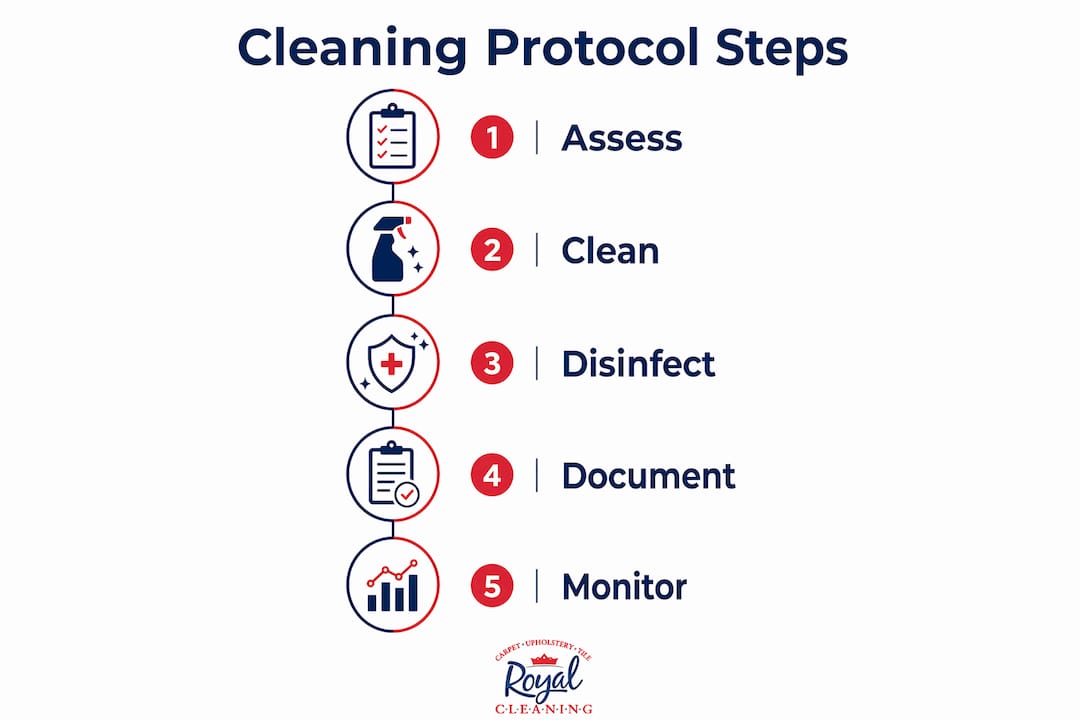
Cleaning physically removes dirt and debris. Disinfecting kills pathogens. Applying a disinfectant to an uncleaned surface is ineffective because organic matter blocks the active ingredient from reaching the pathogen. Every protocol must sequence cleaning before disinfecting, not treat them as interchangeable steps.
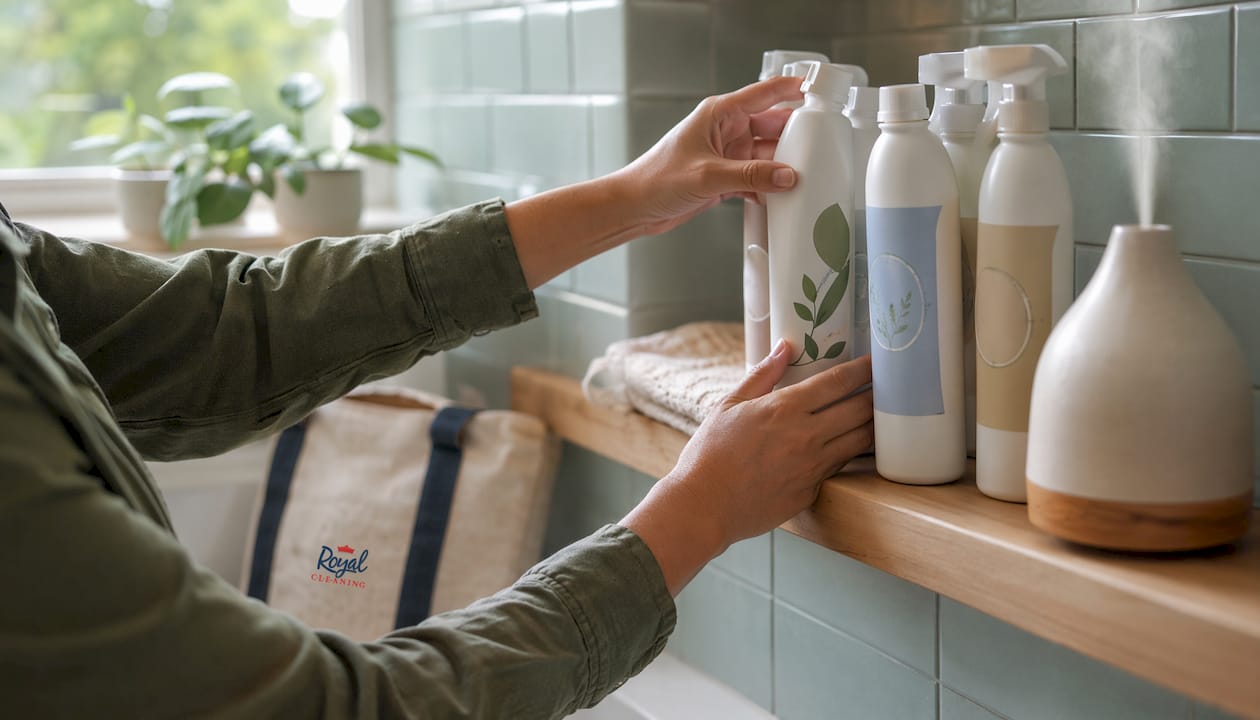
EPA List N registered disinfectants are the baseline requirement for pathogen control in commercial and residential properties. Beyond pathogen efficacy, product selection must also address indoor air quality. Solvent-based cleaners and high-VOC products can trigger IAQ sensor alarms and cause certification failures under WELL v2, even when surfaces appear clean. VOC limits and fragrance-free formulations are mandatory for occupant safety and certification compliance.
Key criteria for compliant product selection:
- EPA List N registration for all disinfectants used on high-touch surfaces
- Green Seal or EPA Safer Choice certification for general-purpose cleaners
- Low or zero VOC content to protect indoor air quality and meet WELL v2 requirements
- Fragrance-free formulations to avoid respiratory irritants for sensitive occupants
- Manufacturer-specified dwell times documented and followed by all cleaning staff
- Annual product list review to remove discontinued or newly restricted chemicals
Eco-friendly cleaning methods aligned with Green Seal and Safer Choice standards also support LEED certification points. Keeping a current chemical inventory with VOC data and certification status protects you during regulatory audits.
Pro Tip: Build your approved product list into your onboarding materials for cleaning staff. If a staff member substitutes an unapproved product during a shift, your certification status is at risk even if the substitution was well-intentioned.
What role does indoor air quality testing play in modern cleaning protocols?
Indoor air quality is a direct outcome of how well your cleaning program works, not a separate concern. Facility managers often focus on visible cleanliness while poor air quality quietly reduces occupant cognitive performance and productivity. Baseline IAQ testing requires sampling at a minimum of one location per 25,000 sq. ft. for each ventilation system, with data collected over three consecutive days.
Industry benchmarks set PM2.5 below 9 μg/m³ and carbon monoxide below 9 ppm over an 8-hour exposure window. CO2 levels above 1,000 ppm indicate poor ventilation and ineffective pollutant removal, regardless of how thorough your surface cleaning is. CO2 is a reliable, low-cost proxy for measuring ventilation performance in occupied buildings.
| IAQ indicator | Acceptable threshold | Action if exceeded |
|---|---|---|
| PM2.5 | Below 9 μg/m³ | Inspect HVAC filters, increase filtration grade |
| Carbon monoxide | Below 9 ppm (8-hour) | Identify combustion sources, increase fresh air intake |
| CO2 | Below 1,000 ppm | Increase ventilation rate, check HVAC operation |
| Humidity | 30%–60% RH | Adjust HVAC controls, inspect for moisture sources |
ASHRAE Standard 62.1-2025 requires mandatory humidity control and upgraded filter efficiency. Residential filtration standards moved from MERV 6 to MERV 11. That shift means older HVAC systems may need hardware upgrades to stay compliant.
Coordinate your cleaning schedule with HVAC operation. A well-structured cleaning program includes scheduling HVAC flushes after chemical application to remove VOCs and airborne contaminants quickly. This integration point is commonly missed by property managers who treat cleaning and mechanical systems as separate departments.
Pro Tip: Install a low-cost CO2 monitor in your highest-occupancy room. If readings climb above 1,000 ppm during business hours, your ventilation rate is insufficient regardless of your cleaning frequency.
How do you document cleaning protocols for audits and compliance?
Written documentation is not a formality. WELL Building v2 Feature X09 mandates a written cleaning policy that includes a product list, cleaning frequency schedule, and high-touch zone documentation. Annual green cleaning staff training and use of certified products are required for certification. Without this paperwork, your physical cleaning efforts cannot be verified or defended.
Documentation gaps cause real failures. Only recording floor-level cleaning rather than surface-level records is a common reason properties fail WELL v2 recertification audits. Electronic logs are more defensible than paper checklists because they carry timestamps, user IDs, and are harder to alter retroactively.
A complete documentation system covers:
- Site-specific written cleaning protocol with task descriptions, frequencies, and responsible parties
- Surface-level cleaning logs organized by zone and surface type, not just by floor
- Chemical inventory records including VOC content, certification status, and safety data sheets
- Staff training records showing annual green cleaning and safety training completion
- Audit response log documenting findings, corrective actions, and follow-up dates
- QR code or digital check-in system for real-time log entry and timestamp verification
Fitwel and LEED standards also reference cleaning documentation as part of occupant health scoring. Keeping records current and organized means you can respond to an audit request within hours rather than days.
What mistakes do property managers make with 2025 cleaning protocols?
The most common mistake is wiping disinfectants before the required dwell time. Rushed cleaning schedules create this hidden compliance gap repeatedly. A disinfectant applied and wiped in 30 seconds may look effective but has not had time to kill pathogens.
Other frequent errors include:
- Skipping high-touch surface routines in busy zones because they “look clean” between scheduled cleans
- Using solvent-based or high-VOC products that trigger IAQ sensor alarms and risk WELL v2 certification
- Incomplete documentation that records floor cleaning but not surface-level or zone-specific tasks
- Failing to coordinate with building mechanical systems, leaving VOCs in the air after chemical application
- Ignoring occupant feedback about odors, irritation, or visible soil between scheduled cleaning cycles
Occupant feedback is an underused data source. Complaints about odors or eye irritation often signal a VOC problem or a ventilation failure before your monitoring equipment catches it. Build a simple feedback channel into your protocol and review it weekly.
Pro Tip: Schedule a quarterly walk-through with your cleaning team lead and a building occupant. Fresh eyes catch missed zones, worn color-coded tools, and product substitutions that internal teams normalize over time.
Key Takeaways
Effective property cleaning protocols 2025 require documented schedules, EPA-compliant products, IAQ monitoring, and surface-level records to satisfy WELL, LEED, and ASHRAE standards.
| Point | Details |
|---|---|
| Daily high-touch disinfection | Clean before disinfecting, and always respect the product’s dwell time. |
| Certified product selection | Use EPA List N and Green Seal or Safer Choice products; avoid high-VOC formulas. |
| IAQ monitoring | Keep CO2 below 1,000 ppm and PM2.5 below 9 μg/m³; upgrade to MERV 11 filters. |
| Surface-level documentation | Log by zone and surface type, not just by floor, to pass WELL v2 audits. |
| HVAC coordination | Schedule ventilation flushes after chemical application to clear airborne VOCs. |
What I’ve learned from watching properties get compliance wrong
I’ve reviewed cleaning programs for properties that looked spotless on the surface and still failed certification audits. The pattern is almost always the same: the physical cleaning was fine, but the documentation was thin and the product list had never been updated.
The shift that actually changes outcomes is moving from reactive to proactive management. Reactive programs clean when something looks dirty. Proactive programs clean on a schedule, test air quality regularly, and treat documentation as part of the job rather than an afterthought. That mindset shift is harder than buying better products or hiring more staff.
The other thing I’ve seen underestimated is the cost of poor air quality. Property managers focus on visible cleanliness because tenants comment on it. But research links poor indoor air quality to measurable cognitive declines that affect occupant productivity. That is a liability issue, not just a comfort issue. When you frame IAQ as a risk management tool rather than a nice-to-have, the investment in air quality monitoring becomes easy to justify.
My honest advice: treat your cleaning protocol as a living document. Review it every six months, update your product list annually, and train your staff on changes before they happen. Properties that do this consistently are the ones that sail through audits and retain tenants.
— Bernadette
How Royal Carpet and Tile Cleaning supports your 2025 compliance needs
Meeting 2025 cleaning standards requires more than a mop and a checklist. Royal Carpet and Tile Cleaning provides professional services in Albuquerque and Rio Rancho that directly support your compliance goals, including EPA-compliant disinfectant application, documented cleaning schedules, and deep extraction services that improve indoor air quality.
Royal Carpet and Tile Cleaning’s commercial carpet cleaning service uses hot-water extraction to remove allergens, particulates, and embedded soils that surface cleaning cannot reach. This directly supports ASHRAE filtration compliance and WELL v2 documentation requirements. The team also provides air duct cleaning services that reduce VOC buildup and improve ventilation performance. Contact Royal Carpet and Tile Cleaning to schedule a consultation and build a cleaning plan that meets your 2025 regulatory requirements.
FAQ
What surfaces require daily disinfection under 2025 protocols?
High-touch surfaces including door handles, elevator buttons, restroom fixtures, and shared equipment require daily disinfection under CDC and OSHA guidelines. High-traffic or high-risk areas may require more frequent cleaning throughout the day.
What is the difference between cleaning and disinfecting?
Cleaning physically removes dirt and debris, while disinfecting kills pathogens with a registered chemical agent. Disinfecting without cleaning first is ineffective because organic matter blocks the active ingredient from reaching the surface pathogen.
How does CO2 level relate to cleaning protocol compliance?
CO2 levels above 1,000 ppm signal poor ventilation, which means airborne contaminants and VOCs from cleaning products are not being removed effectively. Monitoring CO2 gives you a real-time indicator of whether your ventilation and cleaning schedule are working together.
What documentation does WELL Building v2 require for cleaning compliance?
WELL Building v2 Feature X09 requires a written cleaning policy with a product list, frequency schedule, and high-touch zone records. Annual staff training on green cleaning practices and use of certified products are also required for certification.
How often should carpet be professionally cleaned in a commercial property?
Annual hot-water extraction is the standard recommendation for commercial carpets under property maintenance guidelines and ASHRAE compliance schedules. High-traffic areas may require more frequent professional cleaning to maintain IAQ standards and certification eligibility.