(505) 280-5216
Improve workplace air quality at home for better health
TL;DR:
- Indoor air quality in home offices significantly impacts health and cognitive performance.
- Using source control, proper ventilation, and high-efficiency filtration reduces indoor pollutants effectively.
- Albuquerque’s dry, dusty climate requires region-specific IAQ strategies and professional cleaning.
How to improve workplace air quality at home for better health
Your home office might feel like a clean, comfortable place to work, but the air inside it could be working against you. Indoor air often contains a mix of dust, chemicals, and biological particles that accumulate quietly over time. If you work from home in Albuquerque or the surrounding areas, your exposure to these pollutants is longer than most people realize. Research shows that cleaner air can produce 101% higher cognitive scores, which means the air you breathe directly affects how well you think, focus, and feel throughout the day.
Table of Contents
- Why workplace air quality matters—even at home
- Core strategies to improve air quality
- Expert insights: Overlooked factors and local nuances
- Supplemental solutions: Professional cleaning and regular maintenance
- Our take: What most air quality advice misses for Albuquerque homes
- Get professional help for truly clean indoor air
- Frequently asked questions
Key Takeaways
| Point | Details |
|---|---|
| Monitor air quality | Use sensors for PM2.5 and CO2 to track and manage indoor pollution levels. |
| Upgrade filtration systems | Install MERV 13+ filters and portable air cleaners to capture dust and allergens. |
| Balance ventilation | Increase outdoor air safely but watch for excessive dryness or dust in Albuquerque. |
| Schedule professional cleanings | Maintain regular duct, carpet, and upholstery cleaning to reduce persistent sources of indoor pollution. |
Why workplace air quality matters—even at home
Now that you know indoor air matters just as much as outdoor air, let us take a closer look at why quality is so critical in work environments, even at home.
Indoor air quality, commonly called IAQ, refers to the condition of air inside your home as it affects the health and comfort of the people breathing it. When you spend eight or more hours working inside, you are exposed to whatever is floating in that air for the entire workday. The EPA estimates that Americans spend about 90% of their time indoors, and indoor air can be two to five times more polluted than outdoor air.
Three of the most common indoor pollutants are fine particulate matter (called PM2.5), formaldehyde, and carbon monoxide (CO). PM2.5 particles are tiny enough to enter your lungs and bloodstream. Formaldehyde off-gases from furniture, flooring, and cabinetry. CO builds up when combustion appliances are poorly ventilated. Each one carries measurable health risks ranging from eye irritation and headaches to long-term respiratory and cardiovascular damage.
Research published in Nature shows that higher cognitive performance is directly linked to cleaner air, and better ventilation also reduces absenteeism in workplaces. This connection does not disappear just because your office is at home. In fact, it may matter more, since you control your own environment and can actually do something about it.
| Pollutant | Safe benchmark | Common home source |
|---|---|---|
| PM2.5 | Below 12 µg/m³ (annual avg) | Dust, cooking, candles |
| Formaldehyde | Below 0.016 ppm (WHO) | Furniture, flooring, paint |
| CO | Below 9 ppm (8-hour avg) | Gas stoves, water heaters |
| CO2 | Below 1,000 ppm | Breathing, poor ventilation |
“Working in a space with persistently elevated CO2 or PM2.5—even at levels below emergency thresholds—can quietly reduce your focus, increase fatigue, and raise your risk of respiratory illness over time.”
Albuquerque presents its own set of IAQ challenges. The city’s high desert climate creates dry, dusty conditions year-round. Wind events stir up soil particles that seep inside. Older homes in the region may harbor radon, a naturally occurring radioactive gas common in New Mexico geology. Volatile organic compounds (VOCs) from building materials and household products also accumulate faster in tightly sealed homes built for energy efficiency. Following proven IAQ steps tailored to this climate is far more effective than applying generic nationwide advice.
Home offices are often the most neglected rooms in the house when it comes to air quality. They may have limited ventilation, older carpets that trap dust, and electronics that emit trace VOCs. That combination, especially in a dry climate like Albuquerque’s, creates conditions that can quietly reduce your health and performance over time.

Core strategies to improve air quality
Given these health stakes, here is how to take control, with step-by-step approaches every homeowner can start today.
The EPA identifies three primary methods for improving indoor air quality: source control, ventilation, and filtration. Each one targets a different part of the problem, and using all three together gives you the best results.
1. Source control
Source control means reducing or eliminating pollutants before they get into the air. Here is what that looks like in practice:
- Switch to low-VOC or zero-VOC paints, adhesives, and cleaning products.
- Store solvents, pesticides, and harsh chemicals in sealed containers outside the living space, such as a garage or shed.
- Never smoke indoors, and avoid using candles or incense regularly in your home office.
- Choose furniture and flooring labeled with low formaldehyde emissions, especially when remodeling.
- Clean up spills and damp areas quickly to prevent mold growth, which produces its own airborne particles.
2. Ventilation
Ventilation brings fresh outdoor air in while pushing stale indoor air out. ASHRAE, the organization that sets ventilation standards, recommends 5 cfm per person plus 0.06 cfm per square foot for office-type spaces under its 62.1 Ventilation Rate Procedure. In practical terms, this means a 150-square-foot home office should receive at least 14 cfm of fresh air when one person is working inside.
Simple ways to improve ventilation include opening windows during mild weather, using exhaust fans in kitchens and bathrooms, and running a spot ventilation fan to draw fresh air into your workspace. Monitoring CO2 levels with an affordable sensor (ideally below 800 ppm while working) tells you in real time whether your ventilation is adequate.
3. Filtration
Filtration captures airborne particles before they re-enter your breathing zone. Upgrading your HVAC filter to MERV 13 or higher makes a significant difference, as these filters trap PM2.5 particles that lower-rated filters miss. Portable HEPA plus activated carbon air cleaners add another layer: HEPA captures fine particles, while activated carbon adsorbs gases and odors. Understanding duct cleaning benefits is also important, since your HVAC system distributes whatever collects inside your ducts.
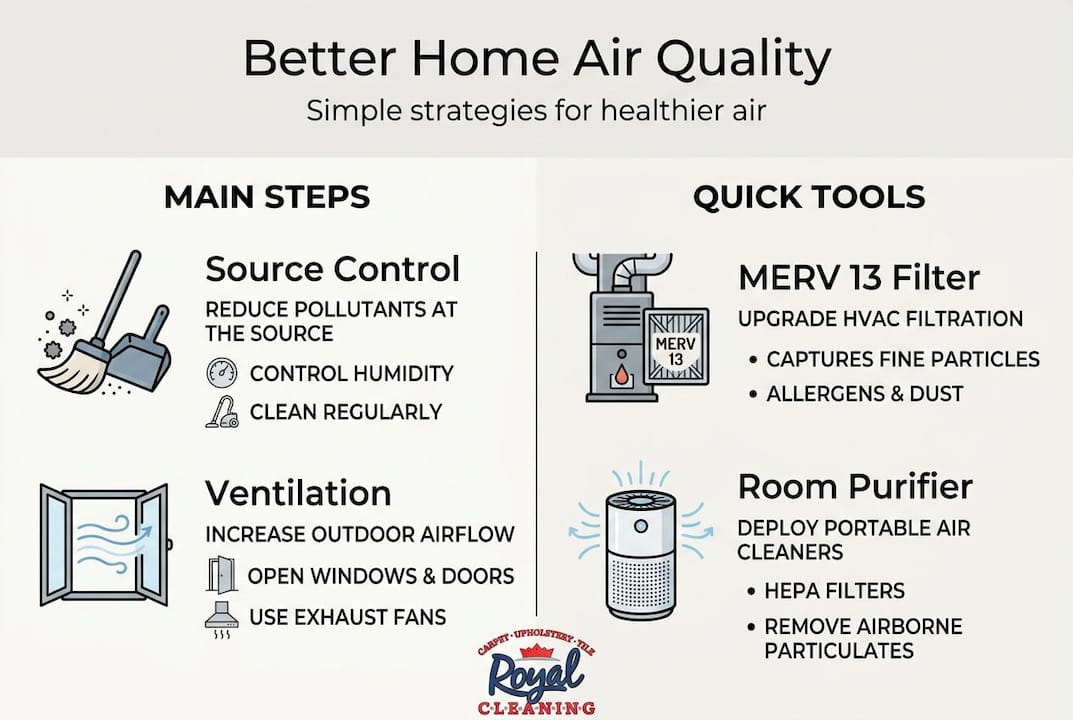
Regular HVAC maintenance, including checking A/C duct cleaning tips, keeps your filtration system running at peak efficiency.
| Strategy | PM2.5 reduction | VOC reduction | CO2 reduction |
|---|---|---|---|
| Source control | Moderate | High | Low |
| Ventilation | Moderate | Moderate | High |
| MERV 13+ filter | High | Low | Low |
| HEPA + carbon cleaner | High | Moderate | Low |
Pro Tip: In Albuquerque, dust infiltration is a year-round issue. Check and replace HVAC filters every 30 to 60 days rather than the standard 90-day recommendation. This simple habit makes a noticeable difference in air clarity and HVAC performance.
Expert insights: Overlooked factors and local nuances
With foundational strategies in place, let us talk about what most guides overlook, subtle challenges and expert advice specific to Albuquerque home offices.
Portable air cleaners are popular, but they have real limitations that most product descriptions do not mention clearly. Research published in Nature confirms that HEPA filters do not remove VOCs, that filter loading and air leaks lower performance over time, and that high-occupancy situations raise pollution levels faster than a single unit can handle. This matters a lot if multiple family members are working or attending school from home in the same space.
Here are several factors most IAQ guides skip entirely:
- Unit sizing: A portable air cleaner rated for 150 square feet will not protect a 300-square-foot room. Always match the unit’s CADR (clean air delivery rate) to your room size.
- Noise levels: Many effective units run loudly at high settings, leading people to run them at lower, less effective speeds. Choose quieter models rated for your room size at medium speed.
- Filter replacement schedules: Running a clogged HEPA filter can actually reduce airflow and allow bypass of unfiltered air around the filter edges.
- HEPA versus activated carbon: HEPA handles particles. Activated carbon handles gases and odors. You need both for comprehensive indoor air protection, especially if your office contains new furniture, fresh paint, or synthetic carpet.
- Radon awareness: New Mexico has elevated radon levels in many areas. Radon is colorless, odorless, and cannot be captured by any air cleaner. The only solution is radon testing followed by professional mitigation if levels exceed 4 pCi/L.
- Low humidity effects: Albuquerque’s dry air can cause nasal passages to dry out, reducing the natural filtration your body provides. Maintaining indoor humidity between 30% and 50% helps, but going too high risks mold growth.
Knowing when to clean your ducts is another key factor that many homeowners overlook until they notice visible dust or worsening allergy symptoms.
Pro Tip: Buy a radon test kit from your local hardware store and leave it in the lowest occupied level of your home for at least 48 hours. If results come back above 4 pCi/L, contact a certified mitigation contractor immediately. This one step protects your family from a serious long-term health risk that no air cleaner can address.
Supplemental solutions: Professional cleaning and regular maintenance
Finally, while self-care goes a long way, supplementing with professional services adds a powerful layer of protection that DIY methods simply cannot match.
Even when you follow every IAQ tip faithfully, particulates still settle. They accumulate inside your air ducts, carpet fibers, upholstered furniture, and along baseboards. Every time your HVAC system cycles on, it stirs up whatever has settled in the ductwork and distributes it throughout your home. This cycle continues until the source is addressed.
Here is how professional cleaning fits into a complete IAQ plan:
- Air duct cleaning: Professional duct cleaning removes accumulated dust, pet dander, mold spores, and debris from inside your HVAC system. According to the EPA’s guidance on IAQ, duct cleaning and deep cleaning are particularly valuable when high particulate levels or persistent dust are present, especially in dry climates like Albuquerque’s. Reviewing the ultimate air duct cleaning guide helps you understand what a thorough professional service should include.
- Carpet and upholstery cleaning: Carpets and upholstery act as reservoirs for PM2.5, allergens, and VOC residues. Regular professional extraction cleaning removes what vacuuming leaves behind.
- Tile and grout cleaning: Bathroom and kitchen surfaces can harbor mold and bacteria that contribute to poor IAQ, especially in humid areas of the home.
- Dryer vent cleaning: Blocked dryer vents reduce airflow efficiency and can contribute to moisture and particulate buildup inside the home.
Portable air cleaners, when used consistently, can cut PM2.5 concentrations by up to 53% in a single room. That is meaningful. But if your ducts are full of dust or your carpets are holding years of accumulated allergens, the air cleaner is fighting a constant battle against a large, persistent source. Professional cleaning attacks that source directly.
For Albuquerque homeowners, the recommended cleaning frequency is more aggressive than national averages suggest. Carpets benefit from professional cleaning every 12 to 18 months. Air ducts should be inspected and cleaned every 2 to 3 years, or sooner if you notice increased dust, worsening allergy symptoms, or visible debris near your vents. Following the Albuquerque IAQ checklist helps you stay on schedule.
Our take: What most air quality advice misses for Albuquerque homes
Most IAQ guides are written for a generic American home in a temperate climate. They assume moderate dust levels, average humidity, and standard building materials. Albuquerque homes do not fit that profile, and applying generic advice without adjusting for local conditions often produces disappointing results.
We see this regularly. A homeowner upgrades to a MERV 13 filter and buys a portable HEPA cleaner, then wonders why the dust still settles within days. The answer is almost always that the source has not been addressed. Dusty ducts, old carpet, and a dry climate that pulls soil particles through every gap in the building envelope keep reloading the air. Following local IAQ tips specific to the region closes that gap.
Another common mistake is overventilating during dry, windy periods. Opening windows when outside PM2.5 levels are high from dust storms, or when outdoor humidity drops below 20%, can actually worsen your indoor air. The EPA recommends balancing fresh air intake with humidity and dust control in dry climates like Albuquerque’s. Monitor outdoor air quality conditions before deciding to open windows, and keep ventilation mechanical during dusty weather.
Integrating research-based strategies with local professional knowledge produces lasting results. That combination is what separates a truly healthy home office from one that just looks clean.
Get professional help for truly clean indoor air
If you are ready to tackle dust and hidden pollutants with confidence, here is how pros can help.
Self-managed IAQ improvements are a strong start, but persistent dust, allergens, and VOCs often require expert-level intervention to fully resolve.
At Royal Cleaning New Mexico, we specialize in air duct cleaning, upholstery cleaning, and carpet cleaning services designed specifically for Albuquerque and surrounding area homes. Our multi-step processes use advanced equipment to remove what everyday cleaning misses, including deeply embedded allergens, fine particles, and residue that keeps recirculating through your HVAC system. We offer transparent pricing, eco-friendly disinfectant options, and a satisfaction guarantee so you can feel confident from the first call. Contact us today to schedule an assessment and give your home office the clean air foundation it deserves.
Frequently asked questions
What are the best filters for improving home office air quality?
MERV 13 or higher filters are the most effective option for capturing PM2.5 and fine allergens in your HVAC system. Pair them with a portable HEPA plus activated carbon cleaner for comprehensive coverage, as the EPA recommends combining multiple methods for the best results.
How often should I clean air ducts or carpets in Albuquerque?
In Albuquerque’s dusty climate, air ducts should be professionally cleaned every 2 to 3 years, and carpets every 12 to 18 months. If you have allergy sufferers in the home, the EPA notes that more frequent cleaning in dusty environments significantly reduces particle accumulation.
Can portable air cleaners remove all indoor air pollutants?
No. Portable units are effective at reducing particles, but research shows they are limited against VOCs and perform poorly in crowded or large spaces. Ventilation and source control must work alongside filtration for complete protection.
Is ventilation always good for air quality in Albuquerque homes?
Not always. During dust storms or dry, windy days, outdoor air quality may be worse than indoors. The EPA advises balancing ventilation with humidity and dust control in dry climates, so monitor outdoor conditions before opening windows.