(505) 280-5216
How vents impact HVAC performance and air quality
Most homeowners assume all vents do the same job: push air in, pull air out, done. That assumption quietly costs you money, comfort, and clean air. Your HVAC system depends on a precise balance of airflow, and the vents you ignore or accidentally block are often the reason your system works harder than it should. In Albuquerque’s dust-heavy climate, where haboobs and seasonal wind events push fine particulates into every corner of your home, balanced airflow in HVAC systems is not a luxury. It’s the foundation of a healthy, efficient home.
Table of Contents
- Understanding vent types and their role in HVAC systems
- Why vent maintenance matters: Air quality, efficiency, and cost
- When and how to clean vents: Albuquerque best practices
- What happens when you close vents? Common myths and risks
- Residential vent and duct cleaning: The next step for Albuquerque homes
- Frequently asked questions
Key Takeaways
| Point | Details |
|---|---|
| Vents are crucial for airflow | Supply and return vents work together to balance comfort and efficiency in your home. |
| Neglecting vents costs money | Dirty or blocked vents can spike energy bills and harm your HVAC system’s lifespan. |
| Routine cleaning isn’t always needed | EPA suggests cleaning only with visible mold or debris, while NADCA advises preventive care every 3-5 years. |
| Closing vents hurts HVAC | Closed vents increase pressure, reduce efficiency, and may cause leaks or damage. |
| Local, certified service matters | For best air quality after Albuquerque dust storms, hire NADCA-certified pros and use strong filters. |
Understanding vent types and their role in HVAC systems
Your home has two types of vents working together: supply vents and return vents. Supply vents push conditioned air (heated or cooled) into each room. Return vents pull that air back to the HVAC unit so it can be filtered, conditioned again, and recirculated. They are a team, and disrupting one side throws the whole system off.
When airflow stays balanced, your system maintains consistent pressure throughout the ductwork. Rooms heat and cool evenly, your HVAC unit runs for shorter cycles, and your energy bills reflect that efficiency. When the balance breaks, you get hot spots, cold spots, and a system that never quite catches up.
Here’s a quick comparison of how each vent type functions:
| Feature | Supply vents | Return vents |
|---|---|---|
| Direction of airflow | Into the room | Back to the HVAC unit |
| Typical location | Floors, walls, ceilings | Walls, hallways, central areas |
| Has a filter? | No | Yes (at the grille or unit) |
| Adjustable louvers? | Usually yes | Usually no |
| Impact if blocked | Uneven temperatures | Pressure imbalance, strain on unit |
Key things every Albuquerque homeowner should know about their vents:
- Return vents are larger because they need to move a high volume of air back to the system.
- Blocking a return vent with furniture is one of the most common and damaging mistakes homeowners make.
- Supply vents can be partially adjusted, but closing them entirely creates pressure problems (more on that in a later section).
- Duct construction standards from ASHRAE duct standards set the baseline for how ducts and vents should be built and maintained to protect both efficiency and air quality.
Understanding your vent layout is the first step. If you want a deeper look at what lives inside those ducts, our air duct cleaning overview walks through what professionals actually find and remove. And if you’re curious about what homeowners can realistically handle themselves, this guide on cleaning air ducts breaks it down clearly.
With the basics established, let’s look at what happens when vents aren’t maintained properly.
Why vent maintenance matters: Air quality, efficiency, and cost
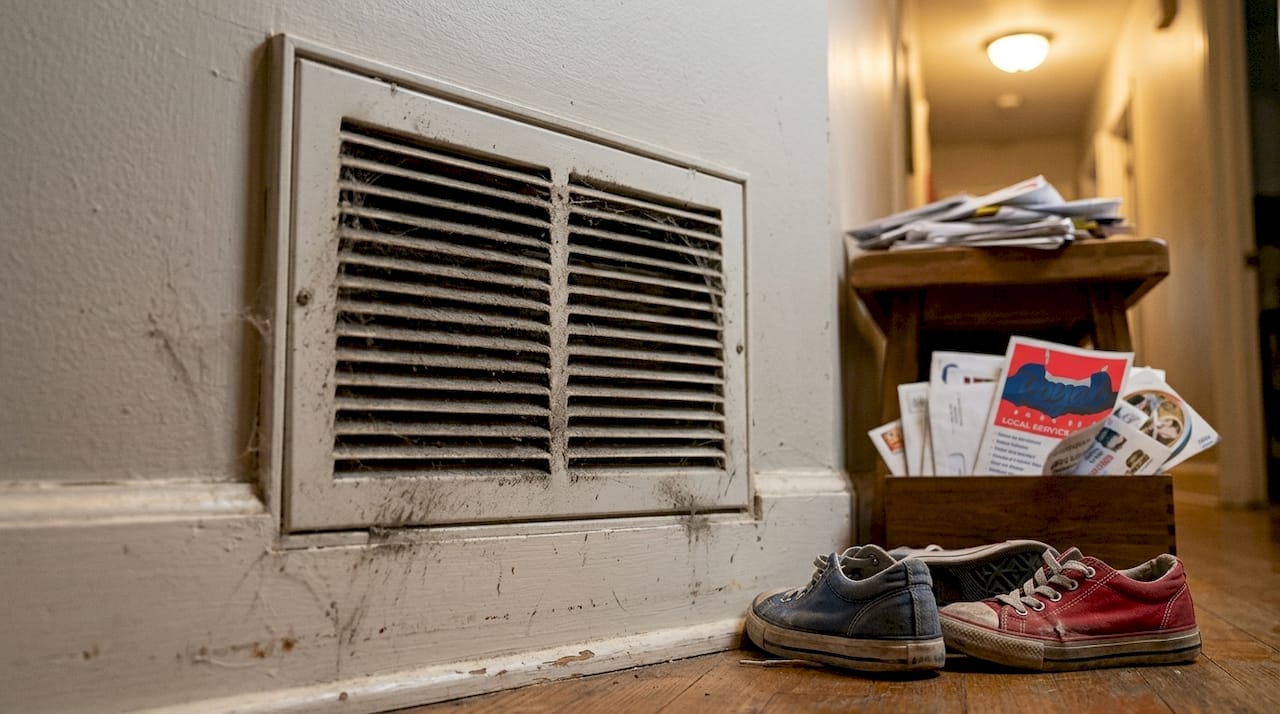
Dirty or blocked vents don’t just look bad. They actively work against your HVAC system. Restricted airflow causes uneven temperatures, longer run cycles, and up to a 30% drop in system efficiency. That means your unit burns more energy to deliver less comfort.
The financial hit compounds over time. Poor vent maintenance can raise your energy bills by 10 to 40% and shorten your HVAC system’s lifespan significantly. A system that should last 15 to 20 years may need replacement in 10 if it’s constantly fighting restricted airflow.
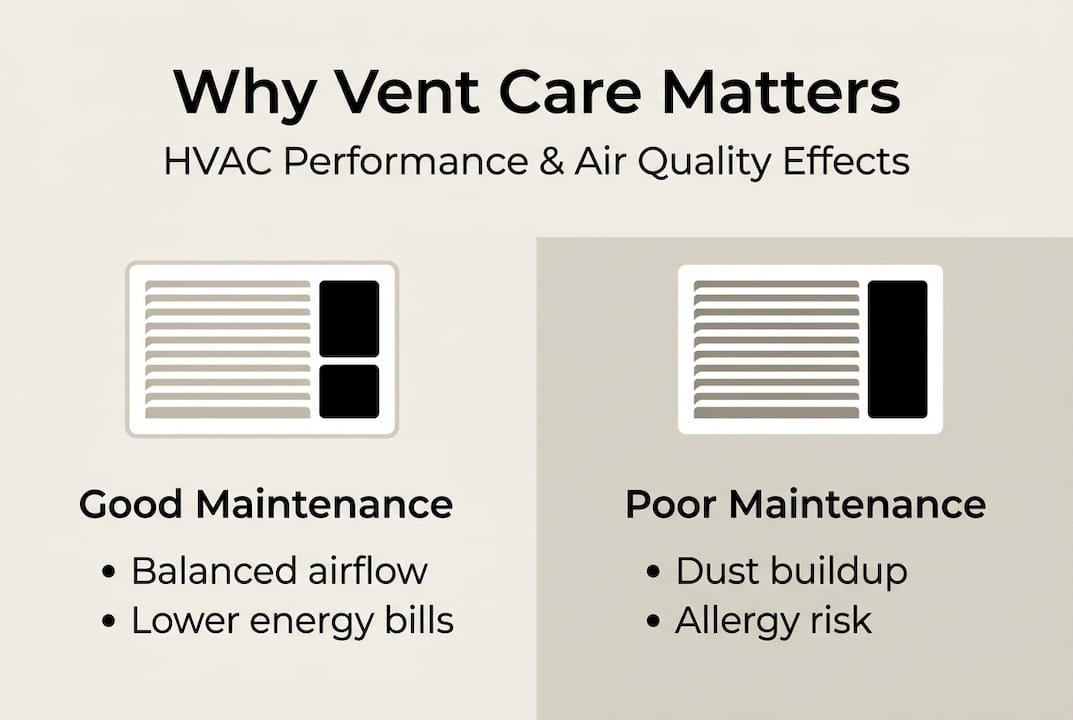
Here’s a snapshot of the real costs:
| Problem | Short-term effect | Long-term consequence |
|---|---|---|
| Blocked return vent | Pressure imbalance | Blower motor strain, early failure |
| Dusty supply vents | Reduced airflow | Higher energy bills |
| Mold in ductwork | Contaminated air | Health risks, full duct remediation |
| Vermin in ducts | Debris and odors | Structural duct damage |
| Neglected filters | Dirty coils | Compressor failure |
For Albuquerque homeowners, there’s an extra layer of risk. Dust storms (locally called haboobs) push fine desert particulates into ductwork through gaps, loose connections, and even return grilles. That dust doesn’t just settle. It coats coils, clogs filters faster, and creates a breeding ground for mold when humidity spikes after monsoon rains.
The health consequences are real. EPA IAQ guidance identifies indoor air as frequently more polluted than outdoor air, and contaminated ducts are a direct contributor. Dust mites, mold spores, pet dander, and even rodent droppings can circulate through your home every time the system runs.
“Your HVAC system is essentially the lungs of your home. When the vents and ducts are dirty, every breath you take indoors reflects that.”
Pro Tip: After any significant Albuquerque dust storm, check your return vent grilles for visible dust buildup. If you can write your name in the dust on the grille, it’s time to inspect the ducts.
Things to watch for that signal a maintenance problem:
- Dust rings or discoloration around vent grilles
- Musty or stale odors when the system kicks on
- Allergy symptoms that worsen indoors
- Rooms that never reach the set temperature
- Visible debris or dark streaks near supply vents
If any of these sound familiar, scheduling duct maintenance sooner rather than later protects both your health and your investment. You can also review the benefits of duct cleaning to understand exactly what a professional service addresses.
Now that we see the risks, how should homeowners approach vent maintenance and cleaning?
When and how to clean vents: Albuquerque best practices
There’s genuine debate among experts about how often ducts need professional cleaning. The EPA recommends cleaning only when specific conditions exist: visible mold growth, vermin infestation, or substantial debris actively releasing into the living space. NADCA (the National Air Duct Cleaners Association) takes a more proactive stance, suggesting every 3 to 5 years as preventive maintenance even without visible problems.
For Albuquerque homes, the EPA’s “wait and see” approach may not be enough. Dust infiltration here is relentless, and the combination of desert particulates and monsoon humidity creates conditions that accelerate contamination. ASHRAE maintenance standards recommend quarterly checks of dampers and coils as part of a complete HVAC maintenance routine.
Here’s a practical inspection and cleaning schedule for local homeowners:
- Monthly: Check and replace air filters. In Albuquerque, MERV 8 to 13 filters catch fine desert dust without overloading the system.
- Quarterly: Inspect return vent grilles for visible dust buildup. Check that furniture hasn’t shifted to block any vents.
- After every major dust storm: Visually inspect all accessible vent grilles. Look for debris, discoloration, or unusual odors when the system runs.
- Annually: Have an HVAC technician inspect coils, dampers, and accessible ductwork for buildup or damage.
- Every 3 to 5 years: Schedule a full professional duct and vent cleaning, especially if you have pets, recent renovations, or allergy concerns.
When choosing a professional service, NADCA certification matters. Certified technicians follow a documented process that includes inspection, agitation, and negative pressure extraction. They don’t just vacuum the grilles. They clean the entire duct system.
Pro Tip: Ask any duct cleaning company whether they use a camera inspection before and after the job. Before-and-after photos give you proof the work was actually done, not just promised.
Combining professional cleaning with upgraded filters is the most effective one-two punch for indoor air quality. MERV 13 filters capture particles as small as 0.3 microns, including fine dust, pollen, and some bacteria. Pair that with a freshly cleaned duct system and you’ll notice the difference in how your home smells and feels.
For a detailed look at what the cleaning process actually involves, our air duct sanitation workflow explains each step. And if you want to avoid the mistakes that make duct cleaning less effective, this guide on duct cleaning mistakes is worth reading before you book anyone. You can also learn more about duct contamination in Albuquerque homes to understand what’s specific to our region.
With clear guidelines in place, let’s tackle one of the most persistent myths homeowners hold about vents.
What happens when you close vents? Common myths and risks
Closing vents in unused rooms feels logical. Why heat or cool a room nobody’s in? The problem is that your HVAC system was designed to move a specific volume of air through all the vents in your home. When you close some of them, that air doesn’t disappear. It builds pressure.
Closing supply vents increases static pressure inside the ductwork, which forces the blower motor to work harder. That extra strain raises energy use, increases wear on the motor, and can cause duct leaks at seams and joints. In cooling season, the added pressure can also cause the evaporator coil to freeze, which shuts the system down entirely.
“Closing vents doesn’t redirect airflow to where you want it. It just creates pressure the system wasn’t built to handle.”
Here’s what actually happens when you close vents:
- Duct pressure rises, stressing seams and connections
- Blower motor works harder, increasing energy consumption
- Evaporator coil can freeze in air conditioning mode
- Duct leaks develop at weak points, sending conditioned air into walls and attics
- Overall system efficiency drops, often negating any savings you hoped to gain
If you genuinely want to control comfort room by room, the right solution is a zoning system, not closed vents. Zoning uses motorized dampers inside the ductwork, controlled by separate thermostats, to direct airflow precisely without creating pressure problems.
For a full breakdown of vent management and what to do instead of closing them, our duct vent cleaning guide covers both maintenance and smart airflow management in practical terms.
Armed with this knowledge, you’re ready to take real steps toward cleaner air and a more efficient home.
Residential vent and duct cleaning: The next step for Albuquerque homes
If reading this has you thinking about what’s actually inside your ducts right now, that instinct is worth acting on. Albuquerque’s climate puts your HVAC system through more than most. Between dust storms, monsoon humidity, and year-round particulate load, your ducts work hard and collect a lot.

At Royal Cleaning New Mexico, we specialize in air duct cleaning services built for the specific demands of Albuquerque and Rio Rancho homes. Our process goes beyond surface cleaning. We use professional-grade equipment to remove contaminants from the entire duct system, not just the grilles you can see. The duct cleaning benefits our customers experience include better airflow, reduced dust on surfaces, and HVAC systems that run more efficiently. Whether you’re overdue for a cleaning or just want a professional assessment after a rough dust season, our find professional vent cleaning resource helps you understand what to expect and how to get started.
Frequently asked questions
How often should HVAC vents and ducts be cleaned?
NADCA recommends every 3 to 5 years for preventive maintenance, while EPA advises cleaning only when you see visible mold, vermin activity, or debris actively releasing into your living space. In Albuquerque, the 3 to 5 year schedule is a smarter baseline given local dust conditions.
Does closing vents help lower energy costs?
No. Closing vents increases pressure, strains the blower motor, and risks duct leaks and coil freeze, which typically raises energy bills rather than lowering them. Use a zoning system if you need room-by-room control.
What are signs that vents or ducts need cleaning?
Visible mold around grilles, dust blowing from supply vents, musty odors when the system runs, or any sign of pest activity are clear signals. After Albuquerque dust storms, a visual inspection of all grilles is always a smart move, even if EPA guidelines don’t require routine cleaning.
How can vent maintenance affect HVAC lifespan?
Neglected vents force your system to work harder, and poor maintenance raises bills by 10 to 40% while cutting years off your system’s life. Regular inspections and timely cleanings are far cheaper than early HVAC replacement.
What’s the best way to improve indoor air quality in Albuquerque homes?
Combine professional duct and vent cleaning with MERV 8 to 13 filters for the strongest results, especially after seasonal dust events. Local duct contamination patterns in Albuquerque make this combination particularly effective for allergy sufferers and families with young children.